


Page 35 - (DK Eyewitness) Travel Guide - The Netherlands
P. 35
A POR TR AIT OF THE NE THERLANDS 33
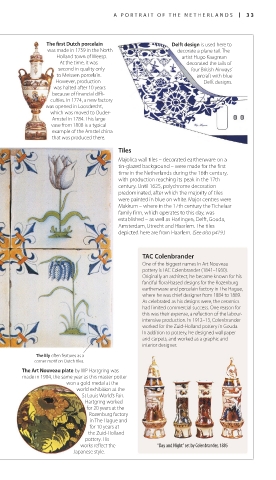
The first Dutch porcelain Delft design is used here to
was made in 1759 in the North decorate a plane tail. The
Holland town of Weesp. artist Hugo Kaagman
At the time, it was decorated the tails of
second in quality only four British Airways’
to Meissen porcelain. aircraft with blue
However, production Delft designs.
was halted after 10 years
because of financial diffi
culties. In 1774, a new factory
was opened in Loosdrecht,
which was moved to Ouder
Amstel in 1784. This large
vase from 1808 is a typical
example of the Amstel china
that was produced there.
Tiles
Majolica wall tiles – decorated earthenware on a
tinglazed background – were made for the first
time in the Netherlands during the 16th century,
with production reaching its peak in the 17th
century. Until 1625, polychrome decoration
predominated, after which the majority of tiles
were painted in blue on white. Major centres were
Makkum – where in the 17th century the Tichelaar
family firm, which operates to this day, was
established – as well as Harlingen, Delft, Gouda,
Amsterdam, Utrecht and Haarlem. The tiles
depicted here are from Haarlem. (See also p419.)
TAC Colenbrander
One of the biggest names in Art Nouveau
pottery is TAC Colenbrander (1841–1930).
Originally an architect, he became known for his
fanciful floralbased designs for the Rozenburg
earthenware and porcelain factory in The Hague,
where he was chief designer from 1884 to 1889.
As celebrated as his designs were, the ceramics
had limited commercial success. One reason for
this was their expense, a reflection of the labour
intensive production. In 1912–13, Colenbrander
worked for the ZuidHolland pottery in Gouda.
In addition to pottery, he designed wallpaper
and carpets, and worked as a graphic and
interior designer.
The lily often features as a
corner motif on Dutch tiles.
The Art Nouveau plate by WP Hartgring was
made in 1904, the same year as this master potter
won a gold medal at the
world exhibition at the
St Louis World’s Fair.
Hartgring worked
for 20 years at the
Rozenburg factory
in The Hague and
for 10 years at
the ZuidHolland
pottery. His
works reflect the “Day and Night” set by Colenbrander, 1885
Japanese style.
032-033_EW_Netherlands.indd 33 16/01/17 12:02 pm

