


Page 33 - (DK Eyewitness) Travel Guide - The Netherlands
P. 33
A POR TR AIT OF THE NE THERLANDS 31
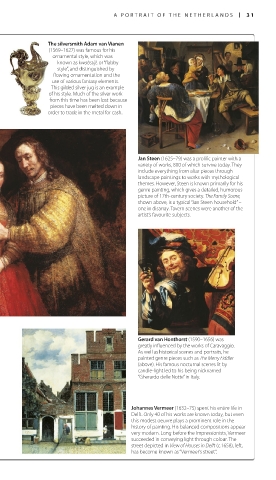
The silversmith Adam van Vianen
(1569–1627) was famous for his
ornamental style, which was
known as kwabstijl, or “flabby
style”, and distinguished by
flowing ornamentation and the
use of various fantasy elements.
This gilded silver jug is an example
of his style. Much of the silver work
from this time has been lost because
pieces have been melted down in
order to trade in the metal for cash.
Jan Steen (1625–79) was a prolific painter with a
variety of works, 800 of which survive today. They
include everything from altar pieces through
landscape paintings to works with mythological
themes. However, Steen is known primarily for his
genre painting, which gives a detailed, humorous
picture of 17th-century society. The Family Scene,
shown above, is a typical “Jan Steen household” –
one in disarray. Tavern scenes were another of the
artist’s favourite subjects.
Gerard van Honthorst (1590–1656) was
greatly influenced by the works of Caravaggio.
As well as historical scenes and portraits, he
painted genre pieces such as The Merry Fiddler
(above). His famous nocturnal scenes lit by
candle-light led to his being nicknamed
“Gherardo delle Notte” in Italy.
Johannes Vermeer (1632–75) spent his entire life in
Delft. Only 40 of his works are known today, but even
this modest oeuvre plays a prominent role in the
history of painting. His balanced compositions appear
very modern. Long before the Impressionists, Vermeer
succeeded in conveying light through colour. The
street depicted in View of Houses in Delft (c.1658), left,
has become known as “Vermeer’s street”.
030-031_EW_Netherlands.indd 31 16/01/17 12:02 pm

