


Page 32 - (DK Eyewitness) Travel Guide - The Netherlands
P. 32
30 INTRODUCING THE NE THERLANDS
The Dutch Masters
The proliferation of painting in the Netherlands
during the 17th century – the country’s Golden Age –
corresponded with the great demand for paintings
among newly rich townspeople. The lack of major royal
and ecclesiastic patrons meant that there was no official
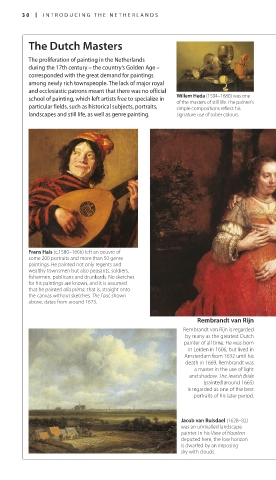
school of painting, which left artists free to specialize in Willem Heda (1594–1680) was one
of the masters of still life. The painter’s
particular fields, such as historical subjects, portraits, simple compositions reflect his
landscapes and still life, as well as genre painting. signature use of sober colours.
Frans Hals (c.1580–1666) left an oeuvre of
some 200 portraits and more than 50 genre
paintings. He painted not only regents and
wealthy townsmen but also peasants, soldiers,
fishermen, publicans and drunkards. No sketches
for his paintings are known, and it is assumed
that he painted alla prima, that is, straight onto
the canvas without sketches. The Fool, shown
above, dates from around 1623.
Rembrandt van Rijn
Rembrandt van Rijn is regarded
by many as the greatest Dutch
painter of all time. He was born
in Leiden in 1606, but lived in
Amsterdam from 1632 until his
death in 1669. Rembrandt was
a master in the use of light
and shadow. The Jewish Bride
(painted around 1665)
is regarded as one of the best
portraits of his later period.
Jacob van Ruisdael (1628–82)
was an unrivalled landscape
painter. In his View of Haarlem
depicted here, the low horizon
is dwarfed by an imposing
sky with clouds.
030-031_EW_Netherlands.indd 30 16/01/17 12:02 pm
Eyewitness Travel LAYERS PRINTED:
Feature template “UK” LAYER
(SourceReport v1.3)
Date 18th October 2012
Size 125mm x 217mm

