


Page 27 - (DK Eyewitness) Travel Guide - Milan & The Lakes
P. 27
THE HIST OR Y OF MILAN 25
Piermarini, who designed the Teatro alla
Scala (see pp54–5), rebuilt Palazzo Reale in
a Neo-Classical style, planned the urban
renewal of the historic centre and designed
the Corso Venezia gardens. The city’s
flourishing cultural life did not diminish
even when the Austrians had to flee from
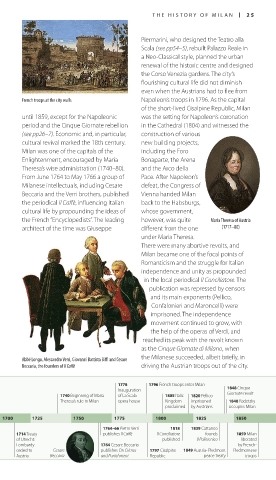
French troops at the city walls Napoleon’s troops in 1796. As the capital
of the short-lived Cisalpine Republic, Milan
until 1859, except for the Napoleonic was the setting for Napoleon’s coronation
period and the Cinque Giornate rebellion in the Cathedral (1804) and witnessed the
(see pp26–7). Economic and, in particular, con struction of various
cultural revival marked the 18th century. new building pro jects,
Milan was one of the capitals of the including the Foro
Enlightenment, encouraged by Maria Bonaparte, the Arena
Theresa’s wise administration (1740–80). and the Arco della
From June 1764 to May 1766 a group of Pace. After Napoleon’s
Milanese intellec tuals, including Cesare defeat, the Congress of
Beccaria and the Verri brothers, published Vienna handed Milan
the periodical Il Caffè, influencing Italian back to the Habsburgs,
cultural life by propounding the ideas of whose government,
the French “Encyclopedists”. The leading however, was quite Maria Theresa of Austria
architect of the time was Giuseppe different from the one (1717–80)
under Maria Theresa.
There were many abortive revolts, and
Milan became one of the focal points of
Romanticism and the struggle for Italian
independence and unity as propounded
in the local periodical Il Conciliatore. The
publication was repressed by censors
and its main exponents (Pellico,
Confalonieri and Maroncelli) were
imprisoned. The independence
movement continued to grow, with
the help of the operas of Verdi, and
reached its peak with the revolt known
as the Cinque Giornate di Milano, when
the Milanese succeeded, albeit briefly, in
Abbé Longo, Alessandro Verri, Giovanni Battista Biffi and Cesare
Beccaria, the founders of Il Caffè driving the Austrian troops out of the city.
1778 1796 French troops enter Milan
1706 Eugene of Inauguration 1848 Cinque
Savoy drives out 1740 Beginning of Maria of La Scala 1805 Italic 1820 Pellico Giornate revolt
last Spanish Theresa’s rule in Milan opera house Kingdom imprisoned 1848 Radetzky
governor proclaimed by Austrians occupies Milan
1700 1725 1750 1775 1800 1825 1850
1764–66 Pietro Verri 1818 1839 Cattaneo
1714 Treaty publishes II Caffè Il Conciliatore founds 1859 Milan
of Utrecht: published Il Politecnico liberated
Lombardy 1764 Cesare Beccaria by French-
ceded to Cesare publishes On Crimes 1797 Cisalpine 1849 Austria- Piedmont Piedmontese
Austria Beccaria and Punishment Republic peace treaty troops
024-025_EW_Milan.indd 25 20/10/16 3:19 pm

