


Page 28 - (DK Eyewitness) Travel Guide - Milan & The Lakes
P. 28
26 introducing milan
The Cinque Giornate Revolt
this historic event was preceded by the “smoking strike”,
held during the first three days of 1848, when the milanese
refused to buy tobacco as a protest against austrian
taxation. the “Five days” revolt began on 18 march 1848.
clashes broke out after a demon stration and continued
in a disorderly fashion for two days, during which the
austrians, led by Field marshal radetzky, were initially
besieged inside the castello Sforzesco. after the formation
of a War council and a Provisional govern ment on
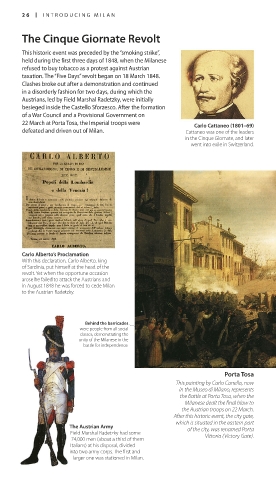
22 march at Porta tosa, the imperial troops were Carlo Cattaneo (1801–69)
defeated and driven out of milan. Cattaneo was one of the leaders
in the Cinque Giornate, and later
went into exile in Switzerland.
Carlo Alberto’s Proclamation
With this declaration, Carlo Alberto, king
of Sardinia, put himself at the head of the
revolt. Yet when the opportune occasion
arose he failed to attack the Austrians and
in August 1848 he was forced to cede Milan
to the Austrian Radetzky.
Behind the barricades
were people from all social
classes, demonstrating the
unity of the Milanese in the
battle for independence.
Porta Tosa
This painting by Carlo Canella, now
in the Museo di Milano, represents
the Battle at Porta Tosa, when the
Milanese dealt the final blow to
the Austrian troops on 22 March.
After this historic event, the city gate,
which is situated in the eastern part
The Austrian Army of the city, was renamed Porta
Field Marshal Radetzky had some Vittoria (Victory Gate).
74,000 men (about a third of them
Italians) at his disposal, divided
into two army corps. The first and
larger one was stationed in Milan.
026-027_EW_Milan.indd 26 16/10/14 1:48 PM
Eyewitness Travel LAYERS PRINTED:
History Portrait template “UK” LAYER
(Source v1.2)
Date 20th August 2012
Size 125mm x 217mm

