


Page 93 - (DK Eyewitness) Travel Guide - Milan & The Lakes
P. 93
SOUTHWEST MILAN 91
Along the Naviglio Grande
Now one of the liveliest quarters in Milan, the Navigli area formed the city’s port
district until the 19th century. Work on the Naviglio Grande canal first began in 1177,
followed by the Pavia, Bereguardo, Martesana and Paderno canals. A system of locks
allowed boats to travel along the canals on different levels (Candoglia marble was
taken to the Duomo of Milan in the 14th century in this way).
Lodovico il Moro improved this network of canals with the help of Leonardo da
Vinci in the 15th century. Barges arrived laden with coal and salt and departed with
handmade goods and textiles. Some sections of the canals, which once extended for
150 km (93 miles), were filled in during the 1930s and navigation ceased altogether
in 1979. Thanks to the Navigli canals, in 1953 Milan was ranked the 13th port in Italy
despite being landlocked.
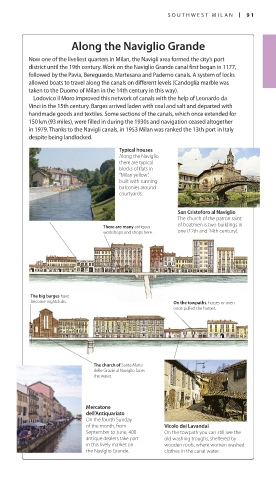
Typical houses
Along the Naviglio
there are typical
blocks of flats in
“Milan yellow”,
built with running
balconies around
courtyards.
San Cristoforo al Naviglio
The church of the patron saint
There are many antiques of boatmen is two buildings in
workshops and shops here. one (12th and 14th century).
The big barges have
become nightclubs. On the towpaths, horses or oxen
once pulled the barges.
The church of Santa Maria
delle Grazie al Naviglio faces
the water.
Mercatone
dell’Antiquariato
On the fourth Sunday
of the month, from Vicolo dei Lavandai
September to June, 400 On the towpath you can still see the
antique dealers take part old washing troughs, sheltered by
in this lively market on wooden roofs, where women washed
the Naviglio Grande. clothes in the canal water.
090-091_EW_Milan.indd 91 20/10/16 3:19 pm

