


Page 94 - (DK Eyewitness) Travel Guide - Milan & The Lakes
P. 94
92 MILAN AREA B Y AREA
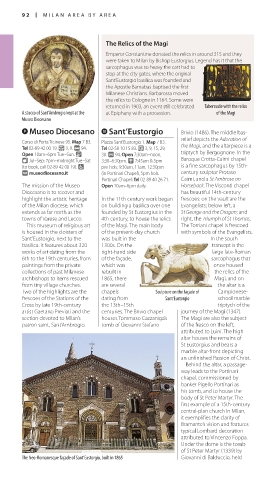
The Relics of the Magi
Emperor Constantine donated the relics in around 315 and they
were taken to Milan by Bishop Eustorgius. Legend has it that the
sarcophagus was so heavy the cart had to
stop at the city gates, where the original
Sant’Eustorgio basilica was founded and
the Apostle Barnabas bap tised the first
Milanese Christians. Barbarossa moved
the relics to Cologne in 1164. Some were
returned in 1903, an event still celebrated Tabernacle with the relics
A stucco of Sant’Ambrogio kept at the at Epiphany with a procession. of the Magi
Museo Diocesano
9 Museo Diocesano 0 Sant’Eustorgio Brivio (1486). The middle bas-
relief depicts the Adoration of
Corso di Porta Ticinese 95. Map 7 B3. Piazza Sant’Eustorgio 1. Map 7 B3.
Tel 02-89 42 00 19. v 3, 9. @ 94. Tel 02-58 10 15 83. v 3, 9, 15, 29, the Magi, and the altarpiece is a
Open 10am–6pm Tue–Sun. & 30. @ 94. Open 7:30am–noon, triptych by Bergognone. In the
8 Jul–Sep: 7pm–midnight Tue–Sat 3:30–6:30pm. 5 7:45am & 5pm Baroque Crotta-Caimi chapel
(to book, call 02-89 42 00 19). 7 pre-hols; 9:30am, 11am, 12:30pm is a fine sarcophagus by 15th-
∑ museodiocesano.it (in Portinari Chapel), 5pm hols. century sculptor Protaso
Portinari Chapel: Tel 02- 89 40 26 71. Caimi, and a St Ambrose on
The mission of the Museo Open 10am–6pm daily. Horseback. The Visconti chapel
Diocesano is to recover and has beautiful 14th-century
highlight the artistic heritage In the 11th century work began frescoes: on the vault are the
of the Milan diocese, which on building a basilica over one Evangelists; below left, a
extends as far north as the founded by St Eustorgius in the St George and the Dragon; and
towns of Varese and Lecco. 4th century, to house the relics right, the Triumph of St Thomas.
This museum of religious art of the Magi. The main body The Torriani chapel is frescoed
is housed in the cloisters of of the present-day church with symbols of the Evan gelists.
Sant’Eustorgio, next to the was built in the In the south
basilica. It features about 320 1300s. On the transept is the
works of art dating from the right-hand side large late-Roman
6th to the 19th centuries, from of the façade, sarcoph agus that
paintings from the private which was once housed
collections of past Milanese rebuilt in the relics of the
archbishops to items rescued 1865, there Magi, and on
from tiny village churches. are several the altar is a
Two of the highlights are the chapels Sculpture on the façade of Campionese-
frescoes of the Stations of the dating from Sant’Eustorgio school marble
Cross by late 19th-century the 13th–15th triptych of the
artist Gaetano Previati and the centuries. The Brivio chapel journey of the Magi (1347).
section devoted to Milan’s houses Tommaso Cazzaniga’s The Magi are also the subject
patron saint, Sant’Ambrogio. tomb of Giovanni Stefano of the fresco on the left,
attrib uted to Luini. The high
altar houses the remains of
St Eustorgius and bears a
marble altar-front depicting
an unfinished Passion of Christ.
Behind the altar, a passage-
way leads to the Portinari
chapel, commissioned by
banker Pigello Portinari as
his tomb, and to house the
body of St Peter Martyr. The
first example of a 15th-century
central-plan church in Milan,
it exemplifies the clarity of
Bramante’s vision and features
typical Lombard decoration
attributed to Vincenzo Foppa.
Under the dome is the tomb
of St Peter Martyr (1339) by
The Neo-Romanesque façade of Sant’Eustorgio, built in 1865 Giovanni di Balduccio, held
092-093_EW_Milan.indd 92 20/10/16 3:16 pm

