


Page 16 - All About History - Issue 180-19
P. 16
mongol empire


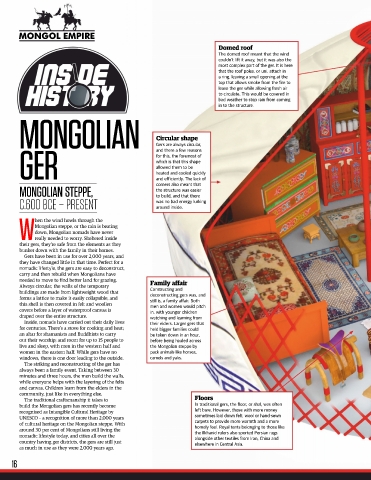
                                                                                                          Domed roof
                                                                                                          The domed roof meant that the wind
                                                                                                          couldn’t lift it away, but it was also the
                                                                                                          most complex part of the ger. It is here
                                                                                                          that the roof poles, or uni, attach in
                                                                                                          a ring, leaving a small opening at the
                                                                                                          top that allows smoke from the fire to
                                                                                                          leave the ger while allowing fresh air
                                                                                                          to circulate. This would be covered in
                                                                                                          bad weather to stop rain from coming
                                                                                                          in to the structure.


          Mongolian                                                         Circular shape


                                                                            Gers are always circular,
          ger                                                               and there a few reasons

                                                                            for this, the foremost of
                                                                            which is that this shape
                                                                            allowed them to be
                                                                            heated and cooled quickly
                                                                            and efficiently. The lack of
                                                                            corners also meant that
          Mongolian Steppe,                                                 the structure was easier

                                                                            to build, and that there
          c.600 BcE – prEsEnt                                               was no bad energy lurking
                                                                            around inside.


                  hen the wind howls through the
                  Mongolian steppe, or the rain is beating
                  down, Mongolian nomads have never
          Wreally needed to worry. Sheltered inside
          their gers, they’re safe from the elements as they
          bunker down with the family in their homes.
             Gers have been in use for over 2,000 years, and
          they have changed little in that time. Perfect for a
          nomadic lifestyle, the gers are easy to deconstruct,
          carry and then rebuild when Mongolians have
          needed to move to find better land for grazing.                Family affair
          Always circular, the walls of the temporary                    Constructing and
          buildings are made from lightweight wood that                  deconstructing gers was, and
          forms a lattice to make it easily collapsible, and             still is, a family affair. Both
          this shell is then covered in felt and woollen                 men and women would pitch
          covers before a layer of waterproof canvas is                  in, with younger children
          draped over the entire structure.                              watching and learning from
             Inside, nomads have carried out their daily lives           their elders. Larger gers that
          for centuries. There’s a stove for cooking and heat;           held bigger families could
          an altar for shamanists and Buddhists to carry                 be taken down in an hour,
          out their worship; and room for up to 15 people to             before being hauled across
          live and sleep, with men in the western half and               the Mongolian steppe by
          women in the eastern half. While gers have no                  pack animals like horses,
          windows, there is one door leading to the outside.             camels and yaks.
             The striking and reconstructing of the ger has
          always been a family event. Taking between 30
          minutes and three hours, the men build the walls,
          while everyone helps with the layering of the felts
          and canvas. Children learn from the elders in the
          community, just like in everything else.
             The traditional craftsmanship it takes to                                        Floors
          build the Mongolian gers has recently become                                        In traditional gers, the floor, or shal, was often
          recognised as Intangible Cultural Heritage by                                       left bare. However, those with more money
          UNESCO – a recognition of more than 2,000 years                                     sometimes laid down felt, wool or hand-sewn
          of cultural heritage on the Mongolian steppe. With                                  carpets to provide more warmth and a more
          around 30 per cent of Mongolians still living the                                   homely feel. Royal tents belonging to those like
                                                                                              the Ilkhanid rulers also sported Persian rugs
          nomadic lifestyle today, and cities all over the                                    alongside other textiles from Iran, China and
          country having ger districts, the gers are still just                               elsewhere in Central Asia.
          as much in use as they were 2,000 years ago.


       16

