


Page 17 - All About History - Issue 180-19
P. 17
Inside History
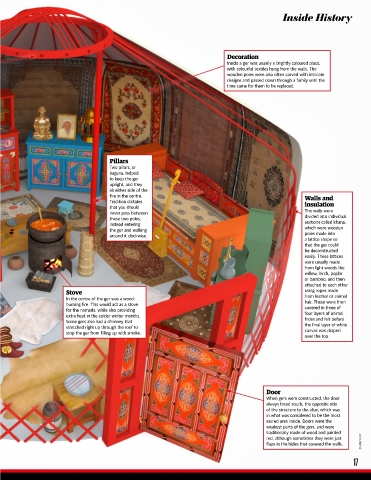
Decoration
Inside a ger was usually a brightly coloured place,
with colourful textiles hung from the walls. The
wooden poles were also often carved with intricate
designs and passed down through a family until the
time came for them to be replaced.
Pillars
Two pillars, or
bagana, helped
to keep the ger
upright, and they
sit either side of the
fire in the centre. Walls and
Tradition dictates insulation
that you should
never pass between The walls were
these two poles, divided into individual
instead entering sections called khana,
the ger and walking which were wooden
around it clockwise. poles made into
a lattice shape so
that the ger could
be deconstructed
easily. These lattices
were usually made
from light woods like
willow, birch, poplar
or bamboo, and then
attached to each other
Stove using ropes made
In the centre of the ger was a wood- from leather or animal
burning fire. This would act as a stove hair. These were then
for the nomads, while also providing covered in three of
extra heat in the colder winter months. four layers of animal
Some gers also had a chimney that hides and felt before
stretched right up through the roof to the final layer of white
stop the ger from filling up with smoke. canvas was draped
over the top.
Door
When gers were constructed, the door
always faced south, the opposite side
of the structure to the altar, which was
in what was considered to be the most
sacred area inside. Doors were the
weakest parts of the gers, and were
traditionally made of wood and painted
red, although sometimes they were just
flaps in the hides that covered the walls. © Adrian Mann
17

