


Page 18 - All About History - Issue 180-19
P. 18
MONGOL EMPIRE
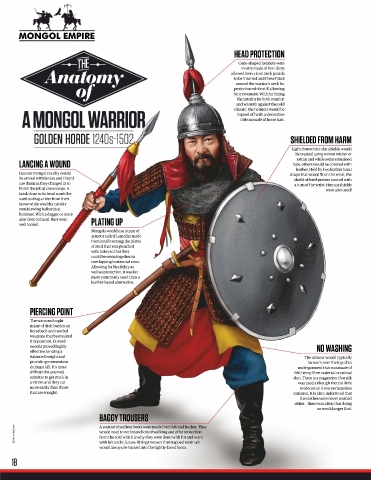
HEADPROTECTION
THE Cone-shaped helmets were
mostly made of iron. Slots
allowed heavy iron neck guards
to be inserted and these fitted
around the warrior’s neck for
protection while still allowing
for movement. With fur lining
the interior for both comfort
and warmth against the cold
climate, the helmets would be
topped off with a decorative
ribbon made of horse hair.
SHIELDEDFROMHARM
Light domed circular shields would
be created using woven wicker or
rattan and while some remained
LANCINGAWOUND bare, others would be covered with
leather. Held by two leather hand
Heavier mongol cavalry would
straps that would fit on the wrist, the
be armed with lances and they’d shield offered precise control with
use them as they charged in to a turn of the wrist. Human shields
finish the job at close range. A
were also used!
hook close to its head would be
used to drag a rider from their
horse while wealthy cavalry
would swing halberds at
footmen. With a dagger or mace
also close to hand, they were PLATINGUP
well tooled.
Mongols would use a type of
armour called Lamellar made
from small rectangular plates
of steel that was punched
with holes so that they
could be sewn together in
overlapping horizontal rows.
Allowing for flexibility as
well as protection, it was far
more commonly used than a
leather-based alternative.
PIERCINGPOINT
The warriors fought
many of their battles on
horseback and needed
weapons that best suited
this position. Curved
swords proved highly NOWASHING
effective, lending a
balanced weight and The armour would typically
providing momentum be worn over the top of an
during a kill. It’s more undergarment that was made of
difficult for a curved felt, hemp fibre material or animal
scimitar to get stuck in skin. There is a suggestion that silk
a victim and they cut was used although there is little
more easily than those evidence so it was perhaps less
that are straight. common. It is also understood that
the clothes were never washed
either – there was a fear that doing
so would anger God.
BAGGYTROUSERS
© Kevin McGivern A warrior’s heelless boots were made from felt and leather. They
would need to withstand lots of walking and offer protection
from the cold which is why they were lined with fur and worn
with felt socks. Loose-fitting trousers that trapped warm air
would always be tucked into the tightly-laced boots.
18

