Page 37 - (DK Eyewitness) Travel Guide - Southwest USA & National Parks
P. 37
A  POR TR AIT  OF   THE  SOUTHWEST      35


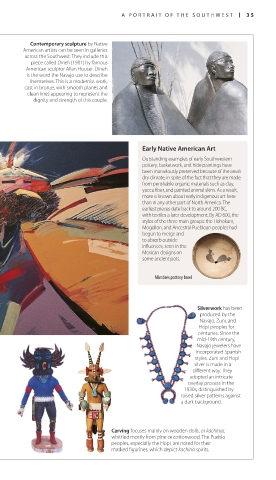
         Contemporary sculpture by Native
       American artists can be seen in galleries
       across the Southwest. They include this
         piece called Dineh (1981) by famous
        American sculptor Allan Houser. Dineh
        is the word the Navajo use to describe
         themselves. This is a modernist work,
       cast in bronze, with smooth planes and
        clean lines appearing to represent the
          dignity and strength of this couple.


                                      Early Native American Art
                                      Outstanding examples of early Southwestern
                                      pottery, basketwork, and hide paintings have
                                      been marvelously preserved because of the area’s
                                      dry climate, in spite of the fact that they are made
                                      from perishable organic materials such as clay,
                                      yucca fiber, and painted animal skins. As a result,
                                      more is known about early indigenous art here
                                      than in any other part of North America. The
                                      earliest pieces date back to around 200 BC,
                                      with textiles a later development. By AD 600, the
                                      styles of the three main groups: the Hohokam,
                                      Mogollon, and Ancestral Puebloan peoples had
                                      begun to merge and
                                      to absorb outside
                                      influences, seen in the
                                      Mexican designs on
                                      some ancient pots.

                                         Mimbres pottery bowl


                                                    Silverwork has been
                                                    produced by the
                                                    Navajo, Zuni, and
                                                    Hopi peoples for
                                                    centuries. Since the
                                                    mid-19th century,
                                                   Navajo jewelers have
                                                   incorporated Spanish
                                                   styles. Zuni and Hopi
                                                   silver is made in a
                                                  different way. They
                                                  adopted an intricate
                                                 overlay process in the
                                                1930s, distinguished by
                                               raised silver patterns against
                                               a dark background.


                              Carving focuses mainly on wooden dolls, or kachinas,
                              whittled mostly from pine or cottonwood. The Pueblo
                              peoples, especially the Hopi, are noted for their
                              masked figurines, which depict kachina spirits.


   034-035_EW_SW_USA.indd   35                              28/11/17   12:39 PM
   32   33   34   35   36   37   38   39   40   41   42