


Page 32 - (DK Eyewitness) Travel Guide - Southwest USA & National Parks
P. 32
30 INTRODUCING THE SOUTHWEST A POR TR AIT OF THE SOUTHWEST 31
Colonizers of the Southwest John Wesley Powell (1834–1902)
The Powell Expedition was
The remote wilderness areas of the Southwest were launched in 1869, when John Raised in Illinois, John Wesley Powell was by any stan dards a
among the last regions of the US to be settled by Anglo- Wesley Powell and nine remarkable man. An early interest in nat ural history
led him to embark on long, solitary expeditions
Americans, in the mid- to late 19th century. The Spanish companions pushed four into the outback to collect geological and
wooden boats out into the
were the first Europeans to reach this area in the 1500s, Green River of Wyoming bound botanical samples. In 1860, he enlisted in the
led by soldier and explorer Francisco Vázquez de for the Colorado River. Several Union army and became a major in the Civil
weeks later, Powell’s party
War. He lost an arm at the Battle of Shiloh, and
Coronado (1510–54), and Santa Fe was established in emerged at the western end the pain was with him for the rest of his life. He
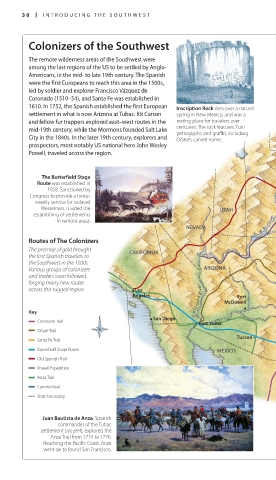
1610. In 1752, the Spanish established the first European Inscription Rock rises over a natural of Grand Canyon (see p147). led two expeditions down the Colorado River, in
settlement in what is now Arizona at Tubac. Kit Carson spring in New Mexico, and was a 1869 and 1871, and went on to run the new US
and fellow fur trappers explored east–west routes in the resting place for travelers over Geological Service and the Bureau of American
mid-19th century, while the Mormons founded Salt Lake centuries. The rock features Zuni Ethnology. He was a staunch campaigner for
petroglyphs and graffiti, including
Native American rights.
City in the 1840s. In the later 19th century, explorers and Oñate’s carved name.
prospectors, most notably US national hero John Wesley John Wesley Powell with Ute Native (see p31)
Powell, traveled across the region.
The Old Spanish Trail was established in 1829.
The Butterfield Stage Colorado R iver It was a major trading route between New Mexico
and California during the mid-19th century.
Route was established in
1858. Sanctioned by COLORADO
Congress to provide a twice-
weekly service for isolated
Westerners, it aided the UTAH
establishing of settlements •
in remote areas. Dodge
NEVADA City
Routes of The Colonizers
Taos Pueblo
The promise of gold brought CALIFORNIA •
the first Spanish travelers to Zuni Santa Fe • Fort Union
the Southwest in the 1500s. Pueblo • William Becknell first traveled
Various groups of colonizers ARIZONA • • Acoma • Las Vegas the Santa Fe Trail in 1821,
and traders soon followed, Pueblo bringing goods by wagon
forging many new routes from Missouri. Spanish soldiers
across this rugged region. • Los bought his wares, and then
Angeles Colorad o R iver McDowell R io Grande MEXICO the wagon trains followed,
NEW
Fort
bringing welcome trade to
Key • the region (see p46).
• San Diego Pecos R iver
Coronado Trail • Fort Yuma
Oñate Trail TEXAS 0 kilometers 100
Tucson •
Santa Fe Trail El Paso 0 miles 100
•
Butterfield Stage Route MEXICO
Old Spanish Trail
Powell Expedition
Anza Trail
Camino Real
State boundary
• Chihuahua
Juan Bautista de Anza, Spanish
commander of the Tubac
settlement (see p94), explored the Juan de Oñate, a Spanish fortune-seeker, Francisco Vázquez de Coronado (1510–1554) headed
first traveled the Camino Real in 1598. He
Anza Trail from 1774 to 1776. named part of this harsh, desert path north from Mexico in 1540 with 336 soldiers and 1,000
Reaching the Pacific Coast, Anza “Journey of the Dead” but safely reached Native Americans to spend two years exploring the
went on to found San Francisco. the Rio Grande (see p43). region. His route became the Coronado Trail.
030-031_EW_SW_USA.indd 30 28/11/17 12:39 PM 030-031_EW_SW_USA.indd 31 28/11/17 12:39 PM
Eyewitness Travel LAYERS PRINTED:
Feature template “UK” LAYER
(SourceReport v1.3)
Date 18th October 2012
Size 125mm x 217mm

