


Page 40 - All About History - Issue 54-17
P. 40
Through History

                                  FARM AND


                   GARDEN TOOLS


                From the simple spade to the combine harvester, the use of tools for

                           cultivating the land stretches back thousands of years

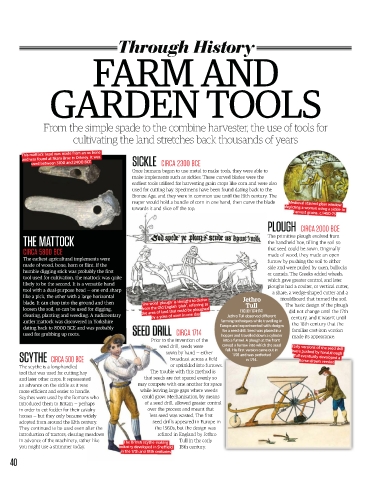
         This mattock head was made from an ox bone
         and was found at Skara Brae in Orkney. It was   SICKLE  CIRCA 2300 BCE
            used between 3100 and 2400 BCE
                                               Once humans began to use metal to make tools, they were able to
                                               make implements such as sickles. These curved blades were the
                                               earliest tools utilised for harvesting grain crops like corn and were also
                                               used for cutting hay. Specimens have been found dating back to the
                                               Bronze Age, and they were in common use until the 19th century. The
                                               reaper would hold a bundle of corn in one hand, then curve the blade   Medieval stained glass window
                                               towards it and slice off the top.                     depicting a woman using a sickle to
                                                                                                        harvest grains, c.1450-75

                                                                                               PLOUGH  CIRCA 2000 BCE
                                                                                               The primitive plough evolved from
         THE MATTOCK                                                                           the handheld hoe, tilling the soil so
         CIRCA 5800 BCE                                                                        that seed could be sown. Originally
                                                                                               made of wood, they made an open
         The earliest agricultural implements were                                             furrow by pushing the soil to either
         made of wood, bone, horn or flint. If the                                             side and were pulled by oxen, bullocks
         humble digging stick was probably the first                                           or camels. The Greeks added wheels,
         tool used for cultivation, the mattock was quite                                      which gave greater control, and later
         likely to be the second. It is a versatile hand                                       ploughs had a coulter, or vertical cutter,
         tool with a dual-purpose head — one end sharp                                           a share, a wedge-shaped cutter and a
         like a pick, the other with a large horizontal                               Jethro        mouldboard that turned the soil.
         blade. It can chop into the ground and then   The word ‘plough’ is thought to derive   Tull  The basic design of the plough
                                                   the area of land that could be ploughed
         loosen the soil, so can be used for digging,   from the Old English ‘ploh’, referring to   ENGLISH 1674-1741  did not change until the 17th
         clearing, planting and weeding. A rudimentary   by a yoke of oxen in one day  Jethro Tull observed different   century, and it wasn’t until
         antler mattock was discovered in Yorkshire                            farming techniques while travelling in   the 18th century that the
                               was probably
         dating back to 8000 BCE and was probably                             Europe and experimented with designs   familiar cast-iron version
                                                                               for a seed drill. Seed was placed in a
         used for grubbing up roots.           SEED DRILL  CIRCA 1714          hopper and travelled down a cylinder   made its appearance.
                                                      Prior to the  invention of the   into a funnel. A plough at the front
                                                         s seed dr rill, seeds were   carved a furrow into which the seed   Early versions of the seed drill
                                                                                fell. His first version came out in
                                                           s sown                  1701 and was perfected   were pushed by hand,though
                                                              n by hand — either
        SCYTHE  CIRCA 500 BCE                                br oadcast across a field   in 1714.       Tull eventually developed a
                                                                                                          horse-drawn version
        The scythe is a long-handled                         or  sprinkled into furrows.
                                                      The trouble
        tool that was used for cutting hay            Th     l with this method is
                                                              not spaced evenly so
        and later other crops. It represente        h that seeds are n
                               ed
                                                              h one another for space
        an advance on the sickle as it was  s    may compete with
                                                  while l
                                                            l ge gaps where weeds
        more efficient and easier to handle. e.   wh l leaving larg
                                  h
        Scythes were used by the Romans s who      coul ld grow. Mec chanisation, by means
                               haps
        introduced them to Britain — perh p         of of a seed drill,  allowed greater control
                                                         h
                                  y
        in order to cut fodder for their cav valry   o over the proc cess and meant that
        horses — but they only became wi idely        less seed wa as wasted. The first
                                  ly
        adopted from around the 12th cen ntury.        seed drills
                                  y
                                                            ll appeared in Europe in
        They continued to be used even a after the     th the 1560s s, but the design was
        introduction of tractors, clearing m meadows    ref   in England by Jethro
                                                        r fined i
        in advance of the machinery, rathe er like              Tull in the early
                                            The British scythe-making
        you might use a strimmer today.    industry developed in Sheffield   18th century.
                                           in the 17th and 18th centuries
     40

