


Page 41 - All About History - Issue 54-17
P. 41
Through History


                                               SECATEURS  CIRCA 1819                   Henry Ford in 1908

                                                                                         early tractors
                                               The 16th and 17th centuries saw an increased   sitting on one of his
                                               interest in gardening, and more specialised tools
                                               began to appear, such as shears to clip fruit trees
                                               and hedges into shape. However, it was not until
                                               the 19th century that small pruning shears, or
                                               secateurs, were introduced. Until then, scissors
                                                         and knives had been used to snip
                                                            away at foliage and small ll
                                                James         branches. Secateurs
                                                Small           were invented by
                                               SCOTTISH 1740-93
                                         Born in Scotland, James Small used   Antoine François
                                        mathematical principles to invent the   Bertrand de
                                        modern swing-plough cast from iron.   Molleville (1744-
                                        Generally known as the Scots plough,   1818), a French
                                        it was much better and more efficient
                                         than its wooden predecessor. Small   nobleman, and
                                         never patented his invention, which   were stronger and
              An advertisement for secateurs   has led some to argue that he   more efficient.
              from 1913. They were considered   wanted it to be free for all
               particularly suitable for ladies  to use.
        LAWNMOWER  1830                                                                TRACTOR  CIRCA 1917
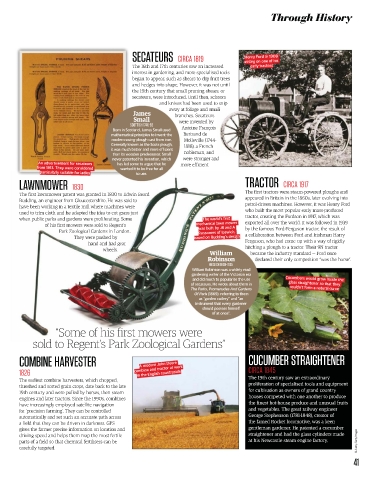
        The first lawnmower patent was granted in 1830 to Edwin Beard                  The first tractors were steam-powered ploughs and
        Budding, an engineer from Gloucestershire. He was said to                      appeared in Britain in the 1860s, later evolving into
                                                                                       petrol-driven machines. However, it was Henry Ford
        have been working in a textile mill where machines were
        used to trim cloth and he adapted the idea to cut grass just                   who built the most popular early mass-produced
        when public parks and gardens were proliferating. Some          The world’s first   tractor, creating the Fordson in 1917, which was
                 of his first mowers were sold to Regent’s            mechanical lawn mower   exported all over the world. It was followed in 1939
                                                                       was built by JR and A
                      Park Zoological Gardens in London.               Ransomes of Ipswich,   by the famous Ford-Ferguson tractor, the result of
                           They were pushed by                       based on Budding’s design  a collaboration between Ford and Irishman Harry
                                hand and had gear                                      Ferguson, who had come up with a way of rigidly
                                     wheels.                                           hitching a plough to a tractor. Their 9N tractor
                                                                           William       became the industry standard — Ford once
                                                                          Robinson         declared their only competition “was the horse”.
                                                                          ENGLISH 1838-1935
                                                                     William Robinson was a widely read
                                                                    gardening writer of the Victorian era
                                                                     and did much to popularise the use   Cucumbers would grow inside the
                                                                    of secateurs. He wrote about them in   glass straightener so that they
                                                                    The Parks, Promenades And Gardens   couldn’t form a natural curve
                                                                     Of Paris (1869), referring to them
                                                                       as “garden cutlery” and “an
                                                                      instrument that every gardener
                                                                        should possess himself
                                                                            of at once”.


                     “Some of his first mowers were
             sold to Regent’s Park Zoological Gardens”


        COMBINE HARVESTER                         A modern John Deere                   CUCUMBER STRAIGHTENER

        1826                                    combine and tractor at work             CIRCA 1845
                                                 in the English countryside
        The earliest combine harvesters, which chopped,                                 The 19th century saw an extraordinary
                                                                                        proliferation of specialised tools and equipment
        threshed and sorted grain crops, date back to the late
                                                                                        for cultivation as owners of grand country
        19th century and were pulled by horses, then steam
        engines and later tractors. Since the 1990s, combines                           houses competed with one another to produce
        have increasingly employed satellite navigation                                 the finest hot-house produce and unusual fruits
        for ‘precision farming’. They can be controlled                                 and vegetables. The great railway engineer
        automatically and set such an accurate path across                              George Stephenson (1781-1848), creator of
        a field that they can be driven in darkness. GPS                                the famed Rocket locomotive, was a keen
        gives the farmer precise information on location and                            gentleman gardener. He patented a cucumber
        driving speed and helps them map the most fertile                               straightener and had the glass cylinders made
        parts of a field so that chemical fertilisers can be                            at his Newcastle steam engine factory.  © Alamy, Getty Images
        carefully targeted.
                                                                                                                             41

