


Page 227 - (DK Eyewitness) Travel Guide 2017 - Alaska
P. 227
ARC TIC AND WESTERN ALASK A 225
The Arctic Tundra
Lying north of the Brooks Range, Alaska’s North Slope encompasses 88,000 sq miles
(227,920 sq km) of largely flat, open Arctic tundra. Derived from the Finnish tunturia,
meaning “treeless land,” this circum polar environment is characterized by low temperatures
and thin topsoil that supports only ground-hugging vegetation such as reindeer mosses,
sedges, lichens, liverworts, berries, dwarf birch, and miniature wildflowers. This thin surface
is underlain by permanently frozen ground known as permafrost. Tundra areas typically
have little precipitation, a growing season of less than 60 days, and average temperatures
of 12° C (54° F) during the summer and around -34° C (-30° F) in the harsh winter. The
average temperature in Anaktuvuk Pass in January, the coldest month, is -23° C (-9° F).
Vibrant miniature
wildflowers carpet
the tundra during
the short flowering
season in summer.
Alaska has about
400 species
of wildflowers.
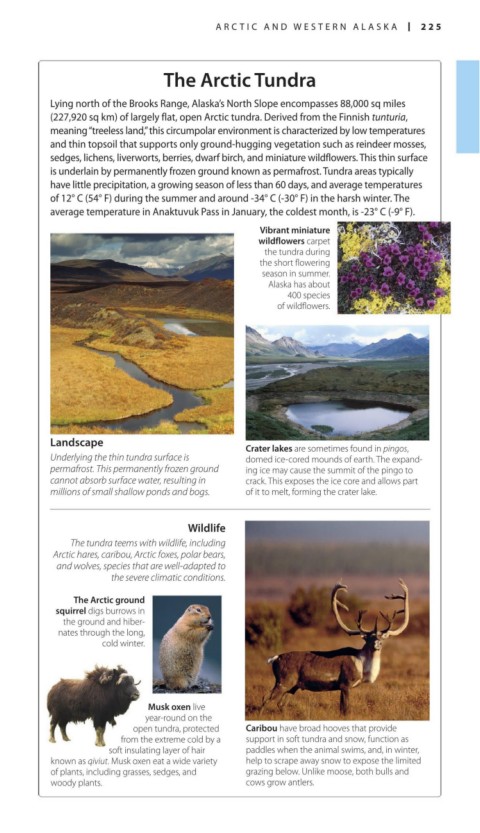
Landscape Crater lakes are sometimes found in pingos,
Underlying the thin tundra surface is domed ice-cored mounds of earth. The expand-
permafrost. This permanently frozen ground ing ice may cause the summit of the pingo to
cannot absorb surface water, resulting in crack. This exposes the ice core and allows part
millions of small shallow ponds and bogs. of it to melt, forming the crater lake.
Wildlife
The tundra teems with wildlife, including
Arctic hares, caribou, Arctic foxes, polar bears,
and wolves, species that are well-adapted to
the severe climatic conditions.
The Arctic ground
squirrel digs burrows in
the ground and hiber-
nates through the long,
cold winter.
Musk oxen live
year-round on the
open tundra, protected Caribou have broad hooves that provide
from the extreme cold by a support in soft tundra and snow, function as
soft insula ting layer of hair paddles when the animal swims, and, in winter,
known as qiviut. Musk oxen eat a wide variety help to scrape away snow to expose the limited
of plants, including grasses, sedges, and grazing below. Unlike moose, both bulls and
woody plants. cows grow antlers.
224-225_EW_Alaska.indd 225 02/05/17 2:32 pm

