


Page 109 - (DK) Help Your Kids with Language Arts
P. 109
107
                                                                                   HYPHENS


          Prefixes

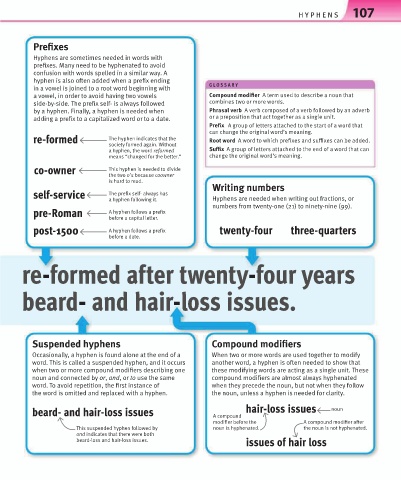
          Hyphens are sometimes needed in words with
          prefixes. Many need to be hyphenated to avoid
          confusion with words spelled in a similar way. A
          hyphen is also often added when a prefix ending
                                                           GLO S S A RY
          in a vowel is joined to a root word beginning with
          a vowel, in order to avoid having two vowels     Compound modifier  A term used to describe a noun that
          side-by-side. The prefix self- is always followed    combines two or more words.
          by a hyphen. Finally, a hyphen is needed when    Phrasal verb  A verb composed of a verb followed by an adverb
          adding a prefix to a capitalized word or to a date.  or a preposition that act together as a single unit.
                                                           Prefix   A group of letters attached to the start of a word that
                                                           can change the original word’s meaning.
          re-formed            The hyphen indicates that the    Root word  A word to which prefixes and suffixes can be added.
                               society formed again. Without
                               a hyphen, the word reformed   Suffix  A group of letters attached to the end of a word that can
                               means “changed for the better.”  change the original word’s meaning.
          co-owner             This hyphen is needed to divide
                               the two o’s because coowner
                               is hard to read.
                                                            Writing numbers
          self-service         The prefix self- always has
                               a hyphen following it.       Hyphens are needed when writing out fractions, or
                                                            numbers from twenty-one (21) to ninety-nine (99).
          pre-Roman            A hyphen follows a prefix
                               before a capital letter.
          post-1500            A hyphen follows a prefix       twenty-four        three-quarters
                               before a date.


       re-formed after twenty-four years


       beard- and hair-loss issues.


          Suspended hyphens                                Compound modifiers

          Occasionally, a hyphen is found alone at the end of a   When two or more words are used together to modify
          word. This is called a suspended hyphen, and it occurs   another word, a hyphen is often needed to show that
          when two or more compound modifiers describing one   these modifying words are acting as a single unit. These
          noun and connected by or, and, or to use the same   compound modifiers are almost always hyphenated
          word. To avoid repetition, the first instance of    when they precede the noun, but not when they follow
          the word is omitted and replaced with a hyphen.  the noun, unless a hyphen is needed for clarity.

          beard- and hair-loss issues                       A compound    hair-loss issues  noun
                                                            modifier before the       A compound modifier after
                      This suspended hyphen followed by     noun is hyphenated.      the noun is not hyphenated.
                      and indicates that there were both
                                                                     issues of hair loss
                      beard-loss and hair-loss issues.

