


Page 110 - (DK) Help Your Kids with Language Arts
P. 110
108 PUNCTU A TION
Quotation marks SEE ALSO
88–89 Direct and indirect speech
QUOTATION MARKS INDICATE DIRECT SPEECH 96–99 Commas
102–103 Colons
OR QUOTED MATERIAL. Italics 122–123
Reading and commenting on texts 192–193
Quotation marks, sometimes simply called quotes, are
Writing to inform 196–197
always used in pairs. In addition to indicating speech Writing to analyze or review 206–207
or a quotation, they can also signal unusual words. Writing a narrative 212–213
Direct speech GLO S S A RY
Quotation marks surround direct speech (text that Direct speech Text that represents
represents spoken words). The material within quotation spoken words.
marks can be split into two sections at either end of Italics A style of type in which the
the sentence, with text in the middle to explain who letters are printed at an angle to
resemble handwriting.
is speaking. Quoted material can also be placed at the
beginning, in the middle, or at the end of a sentence. Quotation Text that reproduces
another author’s exact words.
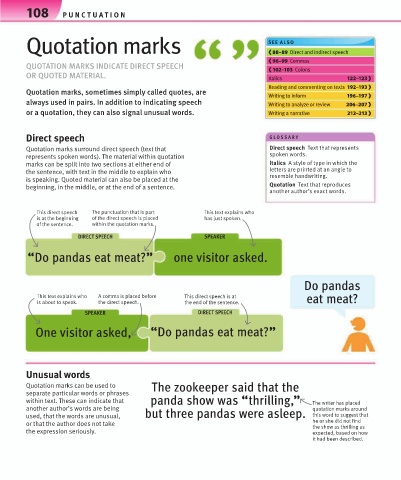
This direct speech The punctuation that is part This text explains who
is at the beginning of the direct speech is placed has just spoken.
of the sentence. within the quotation marks.
DIRECT SPEECH SPEAKER
“Do pandas eat meat?” one visitor asked.
Do pandas
This text explains who A comma is placed before This direct speech is at eat meat?
is about to speak. the direct speech. the end of the sentence.
SPEAKER DIRECT SPEECH
One visitor asked, “Do pandas eat meat?”
Unusual words
Quotation marks can be used to The zookeeper said that the
separate particular words or phrases
within text. These can indicate that panda show was “thrilling,” The writer has placed
another author’s words are being quotation marks around
used, that the words are unusual, but three pandas were asleep. this word to suggest that
or that the author does not take he or she did not find
the show as thrilling as
the expression seriously. expected, based on how
it had been described.

