


Page 24 - (DK) Help Your Kids with Language Arts
P. 24
22 GRAMMAR
Nouns SEE ALSO 24–25
Plurals
Articles 30–31
NOUNS ARE USED TO NAME PEOPLE, ANIMALS, PLACES, OR THINGS.
Determiners 32–33
Pronouns 34–35
Nouns are often known as “naming” words. Every sentence must
Verbs 38–39
include at least one noun or pronoun. Most nouns can be either
Verb agreement 52–53
singular or plural, and can be divided into two main groups:
common and proper nouns.
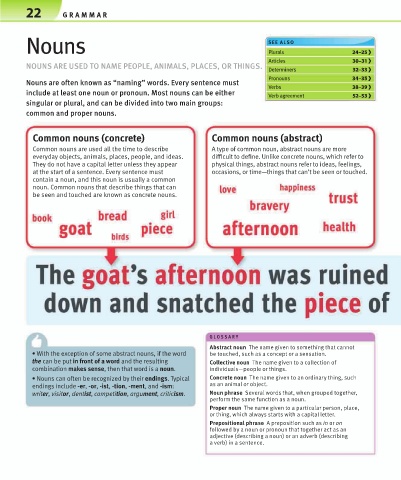
Common nouns (concrete) Common nouns (abstract)
Common nouns are used all the time to describe A type of common noun, abstract nouns are more
everyday objects, animals, places, people, and ideas. difficult to define. Unlike concrete nouns, which refer to
They do not have a capital letter unless they appear physical things, abstract nouns refer to ideas, feelings,
at the start of a sentence. Every sentence must occasions, or time—things that can’t be seen or touched.
contain a noun, and this noun is usually a common
noun. Common nouns that describe things that can
be seen and touched are known as concrete nouns.
GLO S S A RY
Abstract noun The name given to something that cannot
• With the exception of some abstract nouns, if the word be touched, such as a concept or a sensation.
the can be put in front of a word and the resulting Collective noun The name given to a collection of
combination makes sense, then that word is a noun. individuals—people or things.
• Nouns can often be recognized by their endings. Typical Concrete noun The name given to an ordinary thing, such
endings include -er, -or, -ist, -tion, -ment, and -ism: as an animal or object.
writer, visitor, dentist, competition, argument, criticism. Noun phrase Several words that, when grouped together,
perform the same function as a noun.
Proper noun The name given to a particular person, place,
or thing, which always starts with a capital letter.
Prepositional phrase A preposition such as in or on
followed by a noun or pronoun that together act as an
adjective (describing a noun) or an adverb (describing
a verb) in a sentence.

