


Page 28 - (DK) Help Your Kids with Language Arts
P. 28
26 GRAMMAR
Adjectives SEE ALSO
22–23 Nouns
Comparatives and superlatives 28–29
ADJECTIVES ARE WORDS OR PHRASES THAT MODIFY OR DESCRIBE
Articles 30–31
NOUNS OR PRONOUNS. Pronouns 34–35
Verbs 38–39
A noun by itself does not offer much information. If a man wanted
Adverbs 40–41
to buy a shirt in a store, he would need to narrow down what he was Commas 96–99
looking for by using descriptive words like thin or silky. These words Writing to describe 208–209
are known as adjectives.
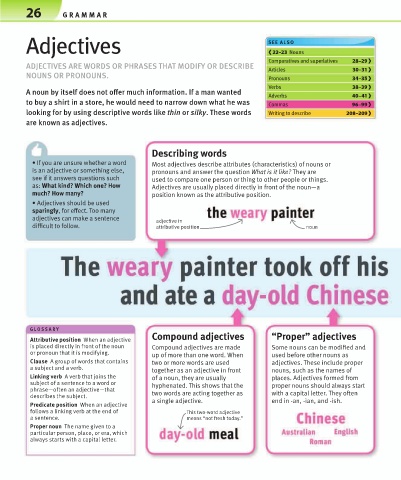
Describing words
• If you are unsure whether a word Most adjectives describe attributes (characteristics) of nouns or
is an adjective or something else, pronouns and answer the question What is it like? They are
see if it answers questions such used to compare one person or thing to other people or things.
as: What kind? Which one? How Adjectives are usually placed directly in front of the noun—a
much? How many? position known as the attributive position.
• Adjectives should be used
sparingly, for effect. Too many
adjectives can make a sentence
adjective in
difficult to follow. attributive position noun
GLO S S A RY
Compound adjectives “Proper” adjectives
Attributive position When an adjective
is placed directly in front of the noun Compound adjectives are made Some nouns can be modified and
or pronoun that it is modifying.
up of more than one word. When used before other nouns as
Clause A group of words that contains two or more words are used adjectives. These include proper
a subject and a verb.
together as an adjective in front nouns, such as the names of
Linking verb A verb that joins the of a noun, they are usually places. Adjectives formed from
subject of a sentence to a word or hyphenated. This shows that the proper nouns should always start
phrase—often an adjective—that
describes the subject. two words are acting together as with a capital letter. They often
a single adjective. end in -an, -ian, and -ish.
Predicate position When an adjective
follows a linking verb at the end of This two-word adjective
a sentence. means “not fresh today.”
Proper noun The name given to a
particular person, place, or era, which
always starts with a capital letter.

