


Page 29 - (DK) Help Your Kids with Language Arts
P. 29
27
                                                                                ADJE CTIVE S


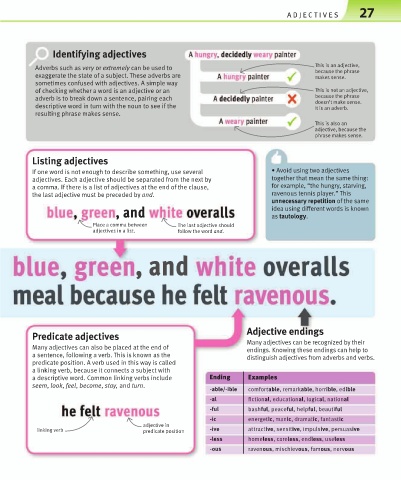
                Identifying adjectives
                                                                                        This is an adjective,
           Adverbs such as very or extremely can be used to                             because the phrase
           exaggerate the state of a subject. These adverbs are                         makes sense.
           sometimes confused with adjectives. A simple way
           of checking whether a word is an adjective or an                             This is not an adjective,
           adverb is to break down a sentence, pairing each                             because the phrase
                                                                                        doesn’t make sense.
           descriptive word in turn with the noun to see if the                         It is an adverb.
           resulting phrase makes sense.
                                                                                        This is also an
                                                                                        adjective, because the
                                                                                        phrase makes sense.


          Listing adjectives
          If one word is not enough to describe something, use several      • Avoid using two adjectives
          adjectives. Each adjective should be separated from the next by    together that mean the same thing:
          a comma. If there is a list of adjectives at the end of the clause,    for example, “the hungry, starving,
          the last adjective must be preceded by and.                       ravenous tennis player.” This
                                                                            unnecessary repetition of the same
                                 , and                                      idea using different words is known
                                                                            as tautology.
                           Place a comma between   The last adjective should
                           adjectives in a list.  follow the word and.


                                      , and


                                                                     Adjective endings
          Predicate adjectives
                                                                     Many adjectives can be recognized by their
          Many adjectives can also be placed at the end of           endings. Knowing these endings can help to
          a sentence, following a verb. This is known as the         distinguish adjectives from adverbs and verbs.
          predicate position. A verb used in this way is called
          a linking verb, because it connects a subject with
          a descriptive word. Common linking verbs include   Ending  Examples
          seem, look, feel, become, stay, and turn.
                                                           -able/-ible  comfortable, remarkable, horrible, edible
                                                           -al       fictional, educational, logical, national
                                                           -ful      bashful, peaceful, helpful, beautiful
                                                           -ic       energetic, manic, dramatic, fantastic
                                        adjective in
           linking verb                 predicate position  -ive     attractive, sensitive, impulsive, persuasive
                                                           -less     homeless, careless, endless, useless
                                                           -ous      ravenous, mischievous, famous, nervous

