


Page 35 - (DK) Help Your Kids with Language Arts
P. 35
33
                                                                              DETERMINERS


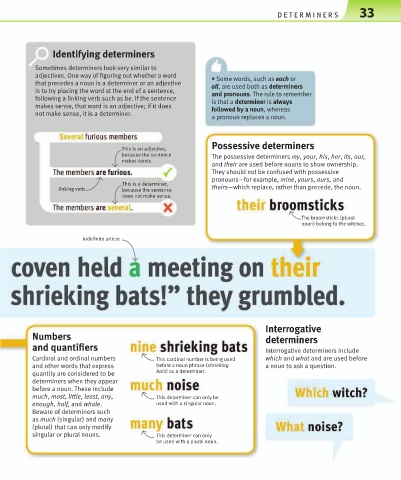
                Identifying determiners
           Sometimes determiners look very similar to
           adjectives. One way of figuring out whether a word   • Some words, such as each or
           that precedes a noun is a determiner or an adjective   all, are used both as determiners
           is to try placing the word at the end of a sentence,   and pronouns. The rule to remember
           following a linking verb such as be. If the sentence   is that a determiner is always
           makes sense, that word is an adjective; if it does    followed by a noun, whereas
           not make sense, it is a determiner.
                                                           a pronoun replaces a noun.


                                                           Possessive determiners
                                   This is an adjective,
                                   because the sentence    The possessive determiners my, your, his, her, its, our,
                                   makes sense.
                                                           and their are used before nouns to show ownership.
                                                           They should not be confused with possessive
                                                           pronouns—for example, mine, yours, ours, and
                                   This is a determiner,
                 linking verb      because the sentence    theirs—which replace, rather than precede, the noun.
                                   does not make sense.


                                                                                    The broomsticks (plural
                                                                                    noun) belong to the witches.

                        indefinite article


                                                                          Interrogative
          Numbers                                                         determiners
          and quantifiers                                                  Interrogative determiners include
          Cardinal and ordinal numbers      This cardinal number is being used   which and what and are used before
          and other words that express      before a noun phrase (shrieking   a noun to ask a question.
          quantity are considered to be     bats) as a determiner.
          determiners when they appear
          before a noun. These include
          much, most, little, least, any,   This determiner can only be
          enough, half, and whole.          used with a singular noun.
          Beware of determiners such
          as much (singular) and many
          (plural) that can only modify
          singular or plural nouns.         This determiner can only
                                            be used with a plural noun.

