


Page 36 - (DK) Help Your Kids with Language Arts
P. 36
34 GRAMMAR
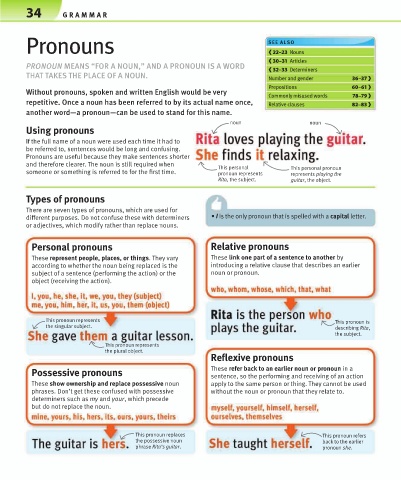
Pronouns SEE ALSO
22–23 Nouns
PRONOUN MEANS “FOR A NOUN,” AND A PRONOUN IS A WORD 30–31 Articles
32–33 Determiners
THAT TAKES THE PLACE OF A NOUN. Number and gender 36–37
Prepositions 60–61
Without pronouns, spoken and written English would be very
Commonly misused words 78–79
repetitive. Once a noun has been referred to by its actual name once, Relative clauses 82–83
another word—a pronoun—can be used to stand for this name.
noun noun
Using pronouns
If the full name of a noun were used each time it had to
be referred to, sentences would be long and confusing.
Pronouns are useful because they make sentences shorter
and therefore clearer. The noun is still required when
This personal This personal pronoun
someone or something is referred to for the first time. pronoun represents represents playing the
Rita, the subject. guitar, the object.
Types of pronouns
There are seven types of pronouns, which are used for
different purposes. Do not confuse these with determiners • I is the only pronoun that is spelled with a capital letter.
or adjectives, which modify rather than replace nouns.
Personal pronouns Relative pronouns
These represent people, places, or things. They vary These link one part of a sentence to another by
according to whether the noun being replaced is the introducing a relative clause that describes an earlier
subject of a sentence (performing the action) or the noun or pronoun.
object (receiving the action).
This pronoun represents This pronoun is
the singular subject. describing Rita,
the subject.
This pronoun represents
the plural object.
Reflexive pronouns
Possessive pronouns These refer back to an earlier noun or pronoun in a
sentence, so the performing and receiving of an action
These show ownership and replace possessive noun apply to the same person or thing. They cannot be used
phrases. Don’t get these confused with possessive without the noun or pronoun that they relate to.
determiners such as my and your, which precede
but do not replace the noun.
This pronoun replaces This pronoun refers
the possessive noun back to the earlier
phrase Rita’s guitar. pronoun she.

