


Page 40 - (DK) Help Your Kids with Language Arts
P. 40
38 GRAMMAR
Verbs SEE ALSO
22–23 Nouns
MOST VERBS ARE ACTION WORDS. 26–27 Adjectives
34–35 Pronouns
Adverbs 40–41
A verb is the most important word in a sentence; without it,
Simple tenses 42–43
the sentence would not make sense. Verbs describe what
Perfect and continuous tenses 44–45
a person or thing is doing or being. Irregular verbs 50–51
Verbs, subjects, and objects
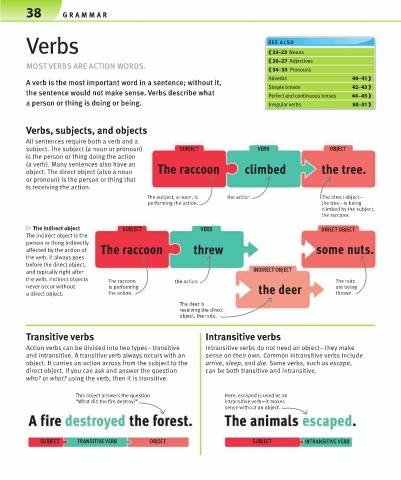
All sentences require both a verb and a
subject. The subject (a noun or pronoun) SUBJECT VERB OBJECT
is the person or thing doing the action
(a verb). Many sentences also have an
object. The direct object (also a noun The raccoon climbed the tree.
or pronoun) is the person or thing that
is receiving the action.
The subject, a noun, is the action The direct object—
performing the action. the tree—is being
climbed by the subject,
the raccoon.
▷ The indirect object SUBJECT VERB DIRECT OBJECT
The indirect object is the
person or thing indirectly
affected by the action of The raccoon threw some nuts.
the verb. It always goes
before the direct object,
and typically right after INDIRECT OBJECT
the verb. Indirect objects The raccoon the action The nuts
never occur without is performing the deer are being
a direct object. the action. thrown.
The deer is
receiving the direct
object, the nuts.
Transitive verbs Intransitive verbs
Action verbs can be divided into two types—transitive Intransitive verbs do not need an object—they make
and intransitive. A transitive verb always occurs with an sense on their own. Common intransitive verbs include
object. It carries an action across from the subject to the arrive, sleep, and die. Some verbs, such as escape,
direct object. If you can ask and answer the question can be both transitive and intransitive.
who? or what? using the verb, then it is transitive.
This object answers the question Here, escaped is used as an
“What did the fire destroy?” intransitive verb—it makes
sense without an object.
SUBJECT TRANSITIVE VERB OBJECT SUBJECT INTRANSITIVE VERB

