


Page 38 - (DK) Help Your Kids with Language Arts
P. 38
36 GRAMMAR
Number and gender SEE ALSO
24–25 Plurals
PRONOUNS AND DETERMINERS MUST AGREE WITH THE NOUNS 32–33 Determiners
34–35 Pronouns
TO WHICH THEY RELATE.
Verbs 38–39
Verb agreement 52–53
In English, there are no personal pronouns or possessive determiners
that can be used to refer to someone without identifying whether
that person is male or female. This often results in mismatched
combinations of singular nouns and plural pronouns or determiners. • If a piece of text is likely to become
clumsy with the repetition of his or
her, try using certain nouns in the
plural form to add variety.
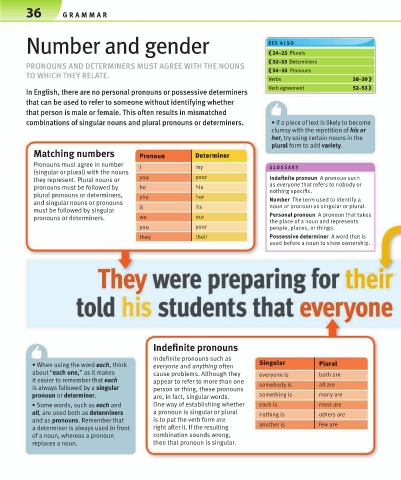
Matching numbers Pronoun Determiner
Pronouns must agree in number I my GLO S S A RY
(singular or plural) with the nouns
they represent. Plural nouns or you your Indefinite pronoun A pronoun such
pronouns must be followed by he his as everyone that refers to nobody or
nothing specific.
plural pronouns or determiners, she her
and singular nouns or pronouns its Number The term used to identify a
noun or pronoun as singular or plural.
must be followed by singular it
pronouns or determiners. we our Personal pronoun A pronoun that takes
the place of a noun and represents
you your people, places, or things.
they their Possessive determiner A word that is
used before a noun to show ownership.
Indefinite pronouns
Indefinite pronouns such as
• When using the word each, think everyone and anything often Singular Plural
about “each one,” as it makes cause problems. Although they everyone is both are
it easier to remember that each appear to refer to more than one
is always followed by a singular person or thing, these pronouns somebody is all are
pronoun or determiner. are, in fact, singular words. something is many are
• Some words, such as each and One way of establishing whether each is most are
all, are used both as determiners a pronoun is singular or plural nothing is others are
and as pronouns. Remember that is to put the verb form are
a determiner is always used in front right after it. If the resulting another is few are
of a noun, whereas a pronoun combination sounds wrong,
replaces a noun. then that pronoun is singular.

