


Page 37 - (DK) Help Your Kids with Language Arts
P. 37
35
                                                                                 PRONOUNS


                                                          Talking about myself
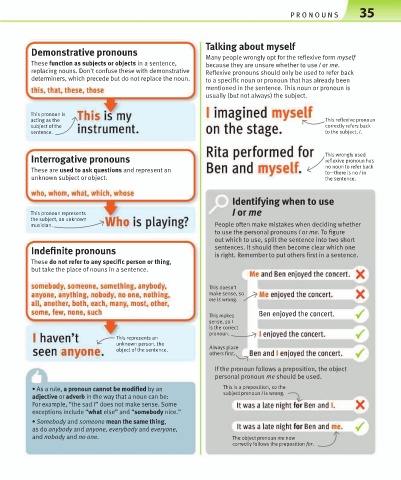
          Demonstrative pronouns
                                                          Many people wrongly opt for the reflexive form myself
          These function as subjects or objects in a sentence,   because they are unsure whether to use I or me.
          replacing nouns. Don’t confuse these with demonstrative   Reflexive pronouns should only be used to refer back
          determiners, which precede but do not replace the noun.  to a specific noun or pronoun that has already been
                                                          mentioned in the sentence. This noun or pronoun is
                                                          usually (but not always) the subject.

          This pronoun is
          acting as the                                                                    This reflexive pronoun
          subject of the                                                                   correctly refers back
          sentence.                                                                        to the subject, I.


                                                                                           This wrongly used
          Interrogative pronouns                                                           reflexive pronoun has
                                                                                           no noun to refer back
          These are used to ask questions and represent an
                                                                                           to—there is no I in
          unknown subject or object.                                                       the sentence.

                                                                 Identifying when to use
          This pronoun represents                                I or me
          the subject, an unknown
          musician.                                         People often make mistakes when deciding whether
                                                            to use the personal pronouns I or me. To figure
                                                            out which to use, split the sentence into two short
          Indefinite pronouns                                sentences. It should then become clear which one
                                                            is right. Remember to put others first in a sentence.
          These do not refer to any specific person or thing,
          but take the place of nouns in a sentence.

                                                           This doesn’t
                                                           make sense, so
                                                           me is wrong.

                                                           This makes   Ben enjoyed the concert.
                                                           sense, so I
                                                           is the correct
                                                           pronoun.
                                 This represents an
                                 unknown person, the       Always place
                                 object of the sentence.
                                                           others first.
                                                            If the pronoun follows a preposition, the object
                                                            personal pronoun me should be used.
          • As a rule, a pronoun cannot be modified by an       This is a preposition, so the
                                                               subject pronoun I is wrong.
          adjective or adverb in the way that a noun can be:
          For example, “the sad I” does not make sense. Some
          exceptions include “what else” and “somebody nice.”
          • Somebody and someone mean the same thing,
          as do anybody and anyone, everybody and everyone,
          and nobody and no one.                                 The object pronoun me now
                                                                 correctly follows the preposition for.

