


Page 57 - (DK) Help Your Kids with Language Arts
P. 57
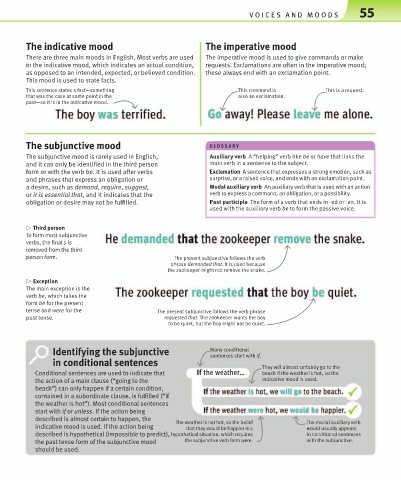
55
                                                                      V OIC E S  AND MOOD S


        The indicative mood                               The imperative mood
        There are three main moods in English. Most verbs are used   The imperative mood is used to give commands or make
        in the indicative mood, which indicates an actual condition,   requests. Exclamations are often in the imperative mood;
        as opposed to an intended, expected, or believed condition.   these always end with an exclamation point.
        This mood is used to state facts.
        This sentence states a fact—something                      This command is         This is a request.
        that was the case at some point in the                     also an exclamation.
        past—so it is in the indicative mood.


        The subjunctive mood                               GLO S S A RY
        The subjunctive mood is rarely used in English,    Auxiliary verb  A “helping” verb like be or have that links the
        and it can only be identified in the third person   main verb in a sentence to the subject.
        form or with the verb be. It is used after verbs   Exclamation  A sentence that expresses a strong emotion, such as
        and phrases that express an obligation or          surprise, or a raised voice, and ends with an exclamation point.
        a desire, such as demand, require, suggest,        Modal auxiliary verb  An auxiliary verb that is used with an action
        or it is essential that, and it indicates that the   verb to express a command, an obligation, or a possibility.
        obligation or desire may not be fulfilled.          Past participle  The form of a verb that ends in -ed or -en. It is
                                                           used with the auxiliary verb be to form the passive voice.

        ▷ Third person
        To form most subjunctive
        verbs, the final s is
        removed from the third
        person form.                             The present subjunctive follows the verb
                                                phrase demanded that. It is used because
                                               the zookeeper might not remove the snake.
        ▷ Exception
        The main exception is the
        verb be, which takes the
        form be for the present
        tense and were for the              The present subjunctive follows the verb phrase
        past tense.                           requested that. The zookeeper wants the boy
                                               to be quiet, but the boy might not be quiet.


                Identifying the subjunctive                Many conditional
                                                           sentences start with if.
                in conditional sentences                                 They will almost certainly go to the
           Conditional sentences are used to indicate that   If the weather…  beach if the weather is hot, so the
           the action of a main clause (“going to the                    indicative mood is used.
           beach”) can only happen if a certain condition,
           contained in a subordinate clause, is fulfilled (“if
           the weather is hot”). Most conditional sentences
           start with if or unless. If the action being
           described is almost certain to happen, the   The weather is not hot, so the belief   The modal auxiliary verb
           indicative mood is used. If the action being   that they would be happier is a   would usually appears
           described is hypothetical (impossible to predict), hypothetical situation, which requires   in conditional sentences
           the past tense form of the subjunctive mood   the subjunctive verb form were.   with the subjunctive.
           should be used.

