


Page 55 - (DK) Help Your Kids with Language Arts
P. 55
53
                                                                         VERB AGREEMENT


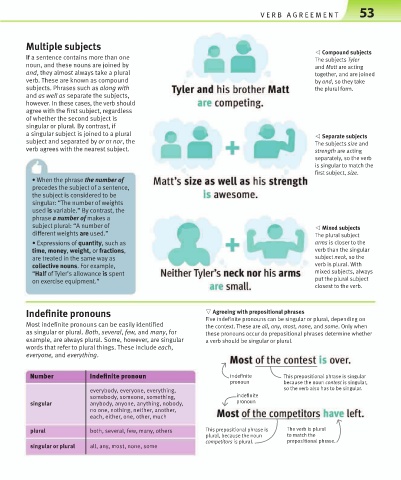
        Multiple subjects
                                                                                        ◁ Compound subjects
        If a sentence contains more than one                                            The subjects Tyler
        noun, and these nouns are joined by                                             and Matt are acting
        and, they almost always take a plural                                           together, and are joined
        verb. These are known as compound                                               by and, so they take
        subjects. Phrases such as along with                                            the plural form.
        and as well as separate the subjects,
        however. In these cases, the verb should
        agree with the first subject, regardless
        of whether the second subject is
        singular or plural. By contrast, if
        a singular subject is joined to a plural                                        ◁ Separate subjects
        subject and separated by or or nor, the                                         The subjects size and
        verb agrees with the nearest subject.                                           strength are acting
                                                                                        separately, so the verb
                                                                                        is singular to match the
                                                                                        first subject, size.
          • When the phrase the number of
          precedes the subject of a sentence,
          the subject is considered to be
          singular: “The number of weights
          used is variable.” By contrast, the
          phrase a number of makes a
          subject plural: “A number of                                                  ◁ Mixed subjects
          different weights are used.”                                                   The plural subject
          • Expressions of quantity, such as                                            arms is closer to the
          time, money, weight, or fractions,                                            verb than the singular
          are treated in the same way as                                                subject neck, so the
          collective nouns. For example,                                                verb is plural. With
          “Half of Tyler’s allowance is spent                                           mixed subjects, always
          on exercise equipment.”                                                       put the plural subject
                                                                                        closest to the verb.


        Indefinite pronouns                                ▽ Agreeing with prepositional phrases
                                                          Five indefinite pronouns can be singular or plural, depending on
        Most indefinite pronouns can be easily identified    the context. These are all, any, most, none, and some. Only when
        as singular or plural. Both, several, few, and many, for   these pronouns occur do prepositional phrases determine whether
        example, are always plural. Some, however, are singular   a verb should be singular or plural.
        words that refer to plural things. These include each,
        everyone, and everything.

         Number           Indefinite pronoun                     indefinite      This prepositional phrase is singular
                                                                pronoun        because the noun contest is singular,
                          everybody, everyone, everything,                     so the verb also has to be singular.
                          somebody, someone, something,           indefinite
         singular         anybody, anyone, anything, nobody,      pronoun
                          no one, nothing, neither, another,
                          each, either, one, other, much

         plural           both, several, few, many, others  This prepositional phrase is   The verb is plural
                                                          plural, because the noun   to match the
                                                          competitors is plural.  prepositional phrase.
         singular or plural  all, any, most, none, some

