


Page 52 - (DK) Help Your Kids with Language Arts
P. 52
50 GRAMMAR
Irregular verbs SEE ALSO
38–39 Verbs
SOME VERBS HAVE ONE OR MORE IRREGULAR FORMS. 42–43 Simple tenses
44–45 Perfect and continuous tenses
The past tense and past participles of all regular verbs are formed 46–47 Participles
48–49 Auxiliary verbs
in the same way. By contrast, irregular verbs are unpredictable,
and take a variety of verb endings. Some change their spelling
completely. It is essential to learn these.
• Auxiliary verbs are irregular, and—
Forming irregular verbs unlike other irregular verbs—the
verbs be, have, and do are irregular
The simple past tense and past participle of regular verbs even in the present tense.
are formed using the ending -ed (or -d, if the infinitive
form already ends in -e). Irregular verbs do not follow this
pattern. They take different endings, and the vowel of a
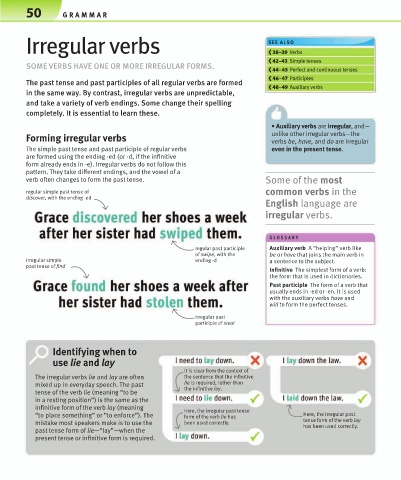
verb often changes to form the past tense. Some of the most
regular simple past tense of common verbs in the
discover, with the ending -ed
English language are
irregular verbs.
GLO S S A RY
regular past participle Auxiliary verb A “helping” verb like
of swipe, with the be or have that joins the main verb in
irregular simple ending -d a sentence to the subject.
past tense of find
Infinitive The simplest form of a verb:
the form that is used in dictionaries.
Past participle The form of a verb that
usually ends in -ed or -en. It is used
with the auxiliary verbs have and
will to form the perfect tenses.
irregular past
participle of steal
Identifying when to
use lie and lay
It is clear from the context of
The irregular verbs lie and lay are often the sentence that the infinitive
mixed up in everyday speech. The past lie is required, rather than
the infinitive lay.
tense of the verb lie (meaning “to be
in a resting position”) is the same as the
infinitive form of the verb lay (meaning Here, the irregular past tense
“to place something” or “to enforce”). The form of the verb lie has Here, the irregular past
mistake most speakers make is to use the been used correctly. tense form of the verb lay
has been used correctly.
past tense form of lie—“lay”—when the
present tense or infinitive form is required.

