


Page 61 - (DK) Help Your Kids with Language Arts
P. 61
59
                                                                            C ONJUNCTIONS


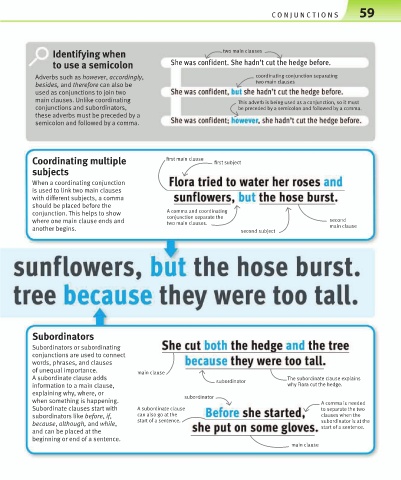
                Identifying when                               two main clauses
                to use a semicolon              She was confident. She hadn’t cut the hedge before.

           Adverbs such as however, accordingly,                       coordinating conjunction separating
                                                                       two main clauses
           besides, and therefore can also be
           used as conjunctions to join two
           main clauses. Unlike coordinating                       This adverb is being used as a conjunction, so it must
           conjunctions and subordinators,                         be preceded by a semicolon and followed by a comma.
           these adverbs must be preceded by a
           semicolon and followed by a comma.


          Coordinating multiple                first main clause  first subject
          subjects
          When a coordinating conjunction
          is used to link two main clauses
          with different subjects, a comma
          should be placed before the
          conjunction. This helps to show      A comma and coordinating
                                               conjunction separate the
          where one main clause ends and       two main clauses.                            second
          another begins.                                          second subject           main clause


          Subordinators
          Subordinators or subordinating
          conjunctions are used to connect
          words, phrases, and clauses
          of unequal importance.       main clause
          A subordinate clause adds                                             The subordinate clause explains
                                                             subordinator
          information to a main clause,                                         why Flora cut the hedge.
          explaining why, where, or                 subordinator
          when something is happening.                                                    A comma is needed
          Subordinate clauses start with   A subordinate clause                           to separate the two
          subordinators like before, if,   can also go at the                             clauses when the
                                       start of a sentence.
          because, although, and while,                                                   subordinator is at the
                                                                                          start of a sentence.
          and can be placed at the
          beginning or end of a sentence.
                                                                                 main clause

