


Page 56 - (DK) Help Your Kids with Language Arts
P. 56
54 GRAMMAR
Voices and moods SEE ALSO
38–39 Verbs
SENTENCES IN ENGLISH CAN BE EXPRESSED 42–43 Simple tenses
46–47 Participles
IN DIFFERENT VOICES AND DIFFERENT MOODS. 48–49 Auxiliary verbs
There are two voices in English. These determine whether 50–51 Irregular verbs
Sentences 68–69
the subject of a sentence is performing or receiving an action. Newspaper articles 198–199
Mood is the form of the verb that conveys the attitude in which
a thought is expressed.
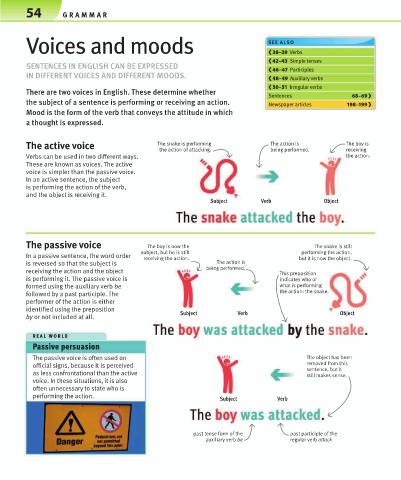
The active voice The snake is performing The action is The boy is
the action of attacking. being performed. receiving
Verbs can be used in two different ways. the action.
These are known as voices. The active
voice is simpler than the passive voice.
In an active sentence, the subject
is performing the action of the verb,
and the object is receiving it.
Subject Verb Object
The passive voice The boy is now the The snake is still
subject, but he is still performing the action,
In a passive sentence, the word order
receiving the action. but it is now the object.
The action is
is reversed so that the subject is being performed.
receiving the action and the object This preposition
is performing it. The passive voice is indicates who or
formed using the auxiliary verb be what is performing
the action: the snake.
followed by a past participle. The
performer of the action is either
identified using the preposition Subject Verb Object
by or not included at all.
REAL W OR L D
Passive persuasion
The passive voice is often used on The object has been
official signs, because it is perceived removed from this
sentence, but it
as less confrontational than the active
still makes sense.
voice. In these situations, it is also
often unnecessary to state who is
performing the action.
Subject Verb
past tense form of the past participle of the
auxiliary verb be regular verb attack

