


Page 73 - (DK) Help Your Kids with Language Arts
P. 73
71
                                                                  C OMPOUND S ENTENC E S


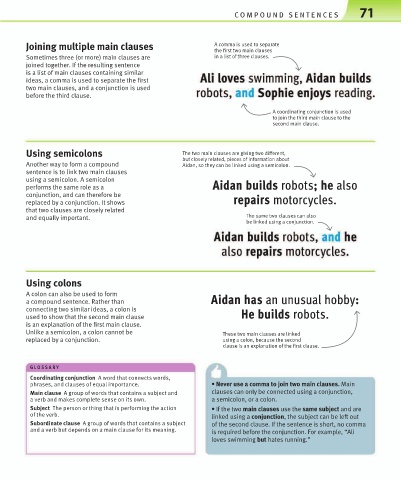
        Joining multiple main clauses                       A comma is used to separate
                                                            the first two main clauses
        Sometimes three (or more) main clauses are          in a list of three clauses.
        joined together. If the resulting sentence
        is a list of main clauses containing similar
        ideas, a comma is used to separate the first
        two main clauses, and a conjunction is used
        before the third clause.

                                                                            A coordinating conjunction is used
                                                                            to join the third main clause to the
                                                                            second main clause.


        Using semicolons                           The two main clauses are giving two different,
                                                   but closely related, pieces of information about
        Another way to form a compound             Aidan, so they can be linked using a semicolon.
        sentence is to link two main clauses
        using a semicolon. A semicolon
        performs the same role as a                         Aidan builds robots; he also
        conjunction, and can therefore be
        replaced by a conjunction. It shows                      repairs motorcycles.
        that two clauses are closely related
        and equally important.                                       The same two clauses can also
                                                                     be linked using a conjunction.


        Using colons
        A colon can also be used to form
        a compound sentence. Rather than                   Aidan has an unusual hobby:
        connecting two similar ideas, a colon is                   He builds robots.
        used to show that the second main clause
        is an explanation of the first main clause.
        Unlike a semicolon, a colon cannot be                 These two main clauses are linked
        replaced by a conjunction.                            using a colon, because the second
                                                              clause is an explanation of the first clause.


         GLO S S A RY
         Coordinating conjunction  A word that connects words,
         phrases, and clauses of equal importance.         • Never use a comma to join two main clauses. Main
         Main clause  A group of words that contains a subject and   clauses can only be connected using a conjunction,
         a verb and makes complete sense on its own.       a semicolon, or a colon.
         Subject  The person or thing that is performing the action   • If the two main clauses use the same subject and are
         of the verb.                                      linked using a conjunction, the subject can be left out
         Subordinate clause  A group of words that contains a subject   of the second clause. If the sentence is short, no comma
         and a verb but depends on a main clause for its meaning.  is required before the conjunction. For example, “Ali
                                                           loves swimming but hates running.”

