


Page 70 - (DK) Help Your Kids with Language Arts
P. 70
68 GRAMMAR
Sentences SEE ALSO
38–39 Verbs
THERE ARE MANY DIFFERENT TYPES OF SENTENCES, VARYING 54–55 Voices and moods
64–65 Phrases
IN COMPLEXITY. 66–67 Clauses
Compound sentences 70–71
A sentence is a unit of written language that contains a subject
Complex sentences 72–73
and a verb and makes complete sense on its own. It must begin Periods and ellipses 94–95
with a capital letter and end with a period, exclamation point, Question marks 110–111
or question mark. Exclamation points 112–113
Simple sentences
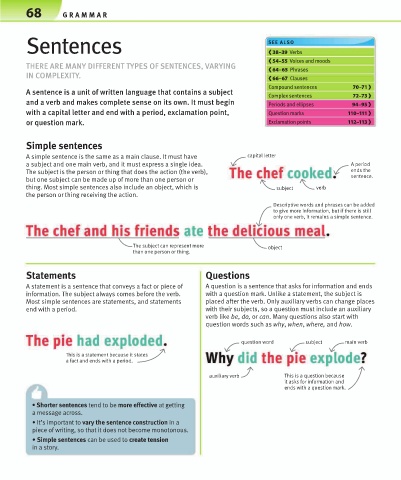
A simple sentence is the same as a main clause. It must have capital letter
a subject and one main verb, and it must express a single idea. A period
The subject is the person or thing that does the action (the verb), ends the
sentence.
but one subject can be made up of more than one person or
thing. Most simple sentences also include an object, which is subject verb
the person or thing receiving the action.
Descriptive words and phrases can be added
to give more information, but if there is still
only one verb, it remains a simple sentence.
The subject can represent more object
than one person or thing.
Statements Questions
A statement is a sentence that conveys a fact or piece of A question is a sentence that asks for information and ends
information. The subject always comes before the verb. with a question mark. Unlike a statement, the subject is
Most simple sentences are statements, and statements placed after the verb. Only auxiliary verbs can change places
end with a period. with their subjects, so a question must include an auxiliary
verb like be, do, or can. Many questions also start with
question words such as why, when, where, and how.
question word subject main verb
This is a statement because it states
a fact and ends with a period.
auxiliary verb This is a question because
it asks for information and
ends with a question mark.
• Shorter sentences tend to be more effective at getting
a message across.
• It’s important to vary the sentence construction in a
piece of writing, so that it does not become monotonous.
• Simple sentences can be used to create tension
in a story.

