


Page 69 - (DK) Help Your Kids with Language Arts
P. 69
67
                                                                                    CLA US E S


        Relative clauses
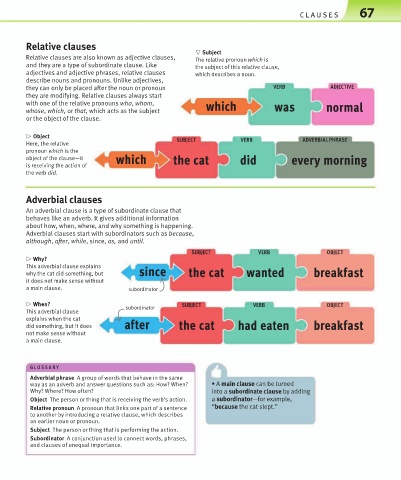
                                                       ▽ Subject
        Relative clauses are also known as adjective clauses,   The relative pronoun which is
        and they are a type of subordinate clause. Like   the subject of this relative clause,
        adjectives and adjective phrases, relative clauses   which describes a noun.
        describe nouns and pronouns. Unlike adjectives,
        they can only be placed after the noun or pronoun                   VERB            ADJECTIVE
        they are modifying. Relative clauses always start
        with one of the relative pronouns who, whom,      which              was           normal
        whose, which, or that, which acts as the subject
        or the object of the clause.

        ▷ Object                                  SUBJECT          VERB             ADVERBIAL PHRASE
        Here, the relative
        pronoun which is the
        object of the clause—it    which         the cat           did           every morning
        is receiving the action of
        the verb did.


        Adverbial clauses
        An adverbial clause is a type of subordinate clause that
        behaves like an adverb. It gives additional information
        about how, when, where, and why something is happening.
        Adverbial clauses start with subordinators such as because,
        although, after, while, since, as, and until.
                                                      SUBJECT           VERB               OBJECT
        ▷ Why?
        This adverbial clause explains
        why the cat did something, but    since      the cat         wanted             breakfast
        it does not make sense without
        a main clause.              subordinator

        ▷ When?                                    SUBJECT             VERB                OBJECT
                                    subordinator
        This adverbial clause
        explains when the cat
        did something, but it does   after        the cat          had eaten            breakfast
        not make sense without
        a main clause.


         GLO S S A RY
         Adverbial phrase  A group of words that behave in the same
         way as an adverb and answer questions such as: How? When?   • A main clause can be turned
         Why? Where? How often?                            into a subordinate clause by adding
         Object  The person or thing that is receiving the verb’s action.  a subordinator—for example,
         Relative pronoun  A pronoun that links one part of a sentence   “because the cat slept.”
         to another by introducing a relative clause, which describes
         an earlier noun or pronoun.
         Subject  The person or thing that is performing the action.
         Subordinator  A conjunction used to connect words, phrases,
         and clauses of unequal importance.

