


Page 68 - (DK) Help Your Kids with Language Arts
P. 68
66 GRAMMAR
Clauses SEE ALSO
22–23 Nouns
A CLAUSE IS THE KEY ELEMENT OF A SENTENCE. 26–27 Adjectives
40–41 Adverbs
A clause is a group of words that contains a subject and a verb. 58–59 Conjunctions
Sentences 68–69
It can form part of a sentence, or a complete simple sentence.
Compound sentences 70–71
Clauses can be main or subordinate, and they can behave like Complex sentences 72–73
adjectives or adverbs. Using clauses correctly 74–75
Relative clauses 82–83
Main clauses
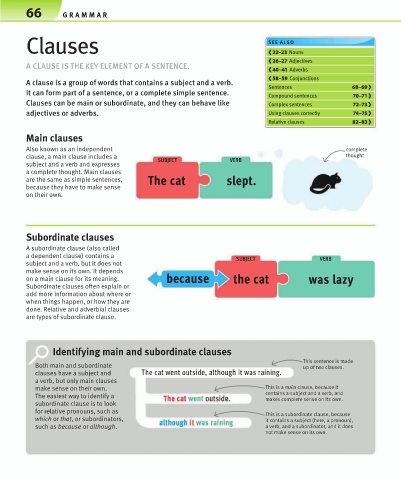
Also known as an independent complete
clause, a main clause includes a SUBJECT VERB thought
subject and a verb and expresses
a complete thought. Main clauses
are the same as simple sentences, The cat slept.
because they have to make sense
on their own.
Subordinate clauses
A subordinate clause (also called
a dependent clause) contains a SUBJECT VERB
subject and a verb, but it does not
make sense on its own. It depends
on a main clause for its meaning. because the cat was lazy
Subordinate clauses often explain or
add more information about where or
when things happen, or how they are
done. Relative and adverbial clauses
are types of subordinate clause.
Identifying main and subordinate clauses
This sentence is made
Both main and subordinate up of two clauses.
clauses have a subject and The cat went outside, although it was raining.
a verb, but only main clauses
make sense on their own. This is a main clause, because it
The easiest way to identify a contains a subject and a verb, and
makes complete sense on its own.
subordinate clause is to look
for relative pronouns, such as This is a subordinate clause, because
which or that, or subordinators, it contains a subject (here, a pronoun),
such as because or although. a verb, and a subordinator, and it does
not make sense on its own.

