


Page 99 - (DK) Help Your Kids with Language Arts
P. 99
97
                                                                                    C OMMAS


                                                           GLO S S A RY
                                                           Adverb  A word that describes the way something happens.
          • Often, quotations are used without introductions, so
                                                           Clause  A grammatical unit that contains a subject and a verb.
          no comma is needed. For example: The guide says that   Conjunction  A word used to connect phrases and sentences.
          this is “the best garden in France.”
                                                           Direct speech  Text that represents spoken words.
          • Don’t use a comma if the first part of the quotation   Interjection  A word or phrase that occurs alone and
          ends with an exclamation point or a question mark. For   expresses emotion.
          example: “Stop!” Tom cried. “The bridge is dangerous.”
                                                           Phrase  A group of words that does not contain a verb.


        Direct speech              A comma is placed before the
                                   quotation mark, after the introduction.
        In direct speech, a comma
        should be used between the       Grandma asked, “Can we
        introduction to the speech
        and the direct speech itself.
        The introduction can be at the   find more of these flowers?”
        start, end, or middle of the
        sentence. When in the middle,   A comma is placed before   A comma is placed
        use a comma on either side    the quotation mark,     before the quotation mark
        of the introduction, between    before an introduction.  after the introduction.
        the first and second parts
        of the sentence.
                                      “The flowers,” Lisa said, “are
                                         always in bloom in May.”


        Direct address
        Commas are always used when someone is spoken to
        directly, by name. The placement of the comma depends    • If an interruption is taken out of a sentence,
        on where the name appears in a sentence. The commas   the sentence should still make sense.
        work in the same way as around an interruption: commas    • Commas with interjections such as stop or help
        to either side of the name when it appears in the middle    work in the same way as those for direct address.
        of a sentence, a comma after the name when it starts
        a sentence, and a comma before the name when it
        comes at the end of a sentence.


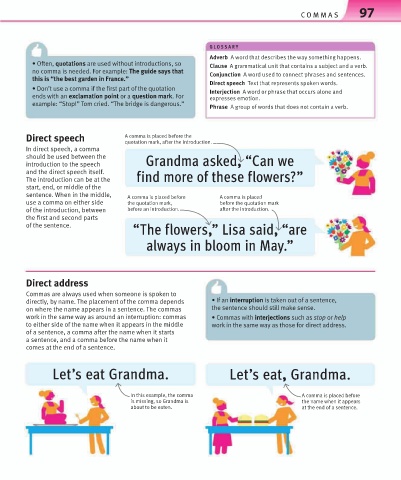
               Let’s eat Grandma.                               Let’s eat, Grandma.


                                     In this example, the comma                     A comma is placed before
                                     is missing, so Grandma is                      the name when it appears
                                     about to be eaten.                             at the end of a sentence.

