


Page 101 - (DK) Help Your Kids with Language Arts
P. 101
99
                                                                O THER US E S  OF  C OMMAS


        Commas in lists                                                   The comma is one
        Commas are used to separate words or phrases in a list. A good    of the most misused
        way to test if the comma is in the correct position is to replace it
        with one of the conjunctions and or or. If the sentence doesn’t   punctuation marks.
        make sense with and or or, don’t add a comma.

                                                     Each interest is separated    The last word in the list
                                                     by a comma from another       is joined by a comma
                                                     interest in the list.         followed by the word and.
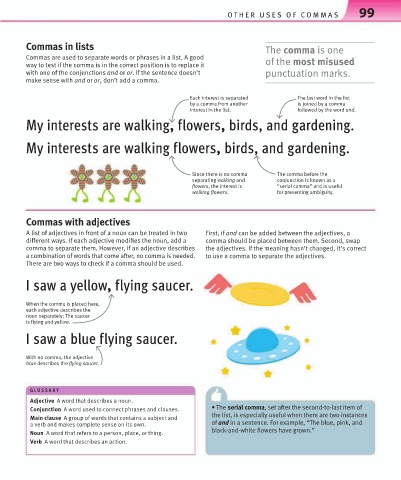
        My interests are walking, flowers, birds, and gardening.


        My interests are walking flowers, birds, and gardening.


                                                      Since there is no comma   The comma before the
                                                      separating walking and   conjunction is known as a
                                                      flowers, the interest is   “serial comma” and is useful
                                                      walking flowers.        for preventing ambiguity.


        Commas with adjectives
        A list of adjectives in front of a noun can be treated in two   First, if and can be added between the adjectives, a
        different ways. If each adjective modifies the noun, add a   comma should be placed between them. Second, swap
        comma to separate them. However, if an adjective describes    the adjectives. If the meaning hasn’t changed, it’s correct
        a combination of words that come after, no comma is needed.   to use a comma to separate the adjectives.
        There are two ways to check if a comma should be used.

        I saw a yellow, flying saucer.


        When the comma is placed here,
        each adjective describes the
        noun separately: The saucer
        is flying and yellow.
        I saw a blue flying saucer.


        With no comma, the adjective
        blue describes the flying saucer.


         GLO S S A RY
         Adjective  A word that describes a noun.
         Conjunction  A word used to connect phrases and clauses.  • The serial comma, set after the second-to-last item of
                                                           the list, is especially useful when there are two instances
         Main clause  A group of words that contains a subject and
         a verb and makes complete sense on its own.       of and in a sentence. For example, “The blue, pink, and
                                                           black-and-white flowers have grown.”
         Noun  A word that refers to a person, place, or thing.
         Verb  A word that describes an action.

