


Page 102 - (DK) Help Your Kids with Language Arts
P. 102
100 PUNCTU A TION
Semicolons SEE ALSO
58–59 Conjunctions
SEMICOLONS CONNECT SECTIONS OF TEXT THAT ARE 66–67 Clauses
94–95 Periods and ellipses
CLOSELY RELATED. 96–99 Commas
Colons 102–103
Semicolons can be used to indicate a close relationship
between main clauses or to separate complex items in
a list. They also precede certain adverbs when they are
used as conjunctions.
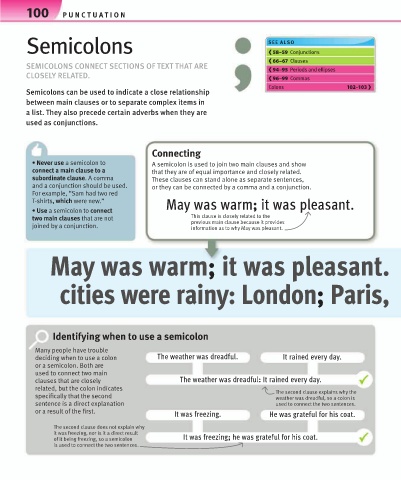
Connecting
• Never use a semicolon to A semicolon is used to join two main clauses and show
connect a main clause to a that they are of equal importance and closely related.
subordinate clause. A comma These clauses can stand alone as separate sentences,
and a conjunction should be used. or they can be connected by a comma and a conjunction.
For example, “Sam had two red
T-shirts, which were new.” May was warm; it was pleasant.
• Use a semicolon to connect
two main clauses that are not This clause is closely related to the
previous main clause because it provides
joined by a conjunction. information as to why May was pleasant.
May was warm; it was pleasant.
cities were rainy: London; Paris,
Identifying when to use a semicolon
Many people have trouble
deciding when to use a colon The weather was dreadful. It rained every day.
or a semicolon. Both are
used to connect two main
clauses that are closely The weather was dreadful: It rained every day.
related, but the colon indicates
The second clause explains why the
specifically that the second weather was dreadful, so a colon is
sentence is a direct explanation used to connect the two sentences.
or a result of the first.
It was freezing. He was grateful for his coat.
The second clause does not explain why
it was freezing, nor is it a direct result
of it being freezing, so a semicolon It was freezing; he was grateful for his coat.
is used to connect the two sentences.

