


Page 104 - (DK) Help Your Kids with Language Arts
P. 104
102 PUNCTU A TION
Colons SEE ALSO
70–71 Compound sentences
THE COLON SEPARATES PARTS OF A SENTENCE, WHILE ALSO 96–99 Commas
100–101 Semicolons
INDICATING A CLOSE RELATIONSHIP BETWEEN THEM. Quotation marks 108–109
Bullet points 116–117
A colon connects a main clause with another clause, a
phrase, or a word. It can be used to provide an explanation
or for emphasis, or to introduce a list or quoted material.
Explanations
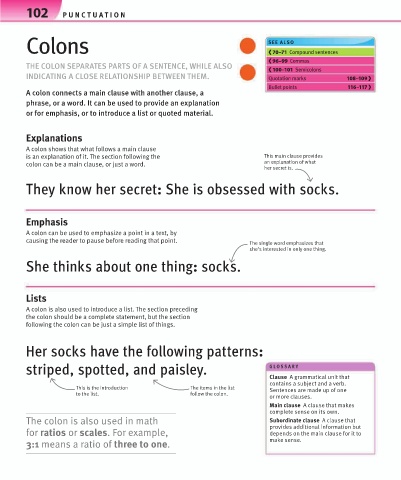
A colon shows that what follows a main clause
is an explanation of it. The section following the This main clause provides
colon can be a main clause, or just a word. an explanation of what
her secret is.
They know her secret: She is obsessed with socks.
Emphasis
A colon can be used to emphasize a point in a text, by
causing the reader to pause before reading that point.
The single word emphasizes that
she’s interested in only one thing.
She thinks about one thing: socks.
Lists
A colon is also used to introduce a list. The section preceding
the colon should be a complete statement, but the section
following the colon can be just a simple list of things.
Her socks have the following patterns:
striped, spotted, and paisley. GLO S S A RY
Clause A grammatical unit that
contains a subject and a verb.
This is the introduction The items in the list Sentences are made up of one
to the list. follow the colon.
or more clauses.
Main clause A clause that makes
complete sense on its own.
The colon is also used in math Subordinate clause A clause that
provides additional information but
for ratios or scales. For example, depends on the main clause for it to
make sense.
3:1 means a ratio of three to one.

