


Page 155 - (DK) Ocean - The Definitive Visual Guide
P. 155
CORAL REEFS 153
Reef Formation
The individual animals that make up corals are called polyps. The polyps of the main group
of reef-building corals, stony corals, secrete limestone, building on the substrate underneath.
The polyps also form colonies that create community skeletons in a variety of shapes. An
important contributor to the life of these corals is the presence within the polyps of tiny
organisms called zooxanthellae, which provide much of the polyps’ nutritional needs.
Other organisms that add their skeletal remains to the reef include mollusks and echinoderms.
Grazing and boring organisms also contribute, by
breaking coral skeletons into sand, which fills gaps
in the developing reef. Algae and other encrusting
organisms help bind the sand and coral fragments
together. Most reefs do not grow continuously but
experience spurts of growth interspersed with
quieter periods, which are sometimes associated
with recovery from storm damage.
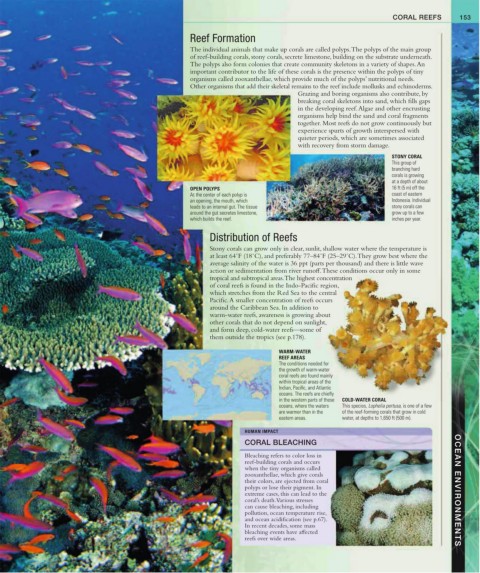
STONY CORAL
This group of
branching hard
corals is growing
at a depth of about
OPEN POLYPS 16 ft (5 m) off the
At the center of each polyp is coast of eastern
an opening, the mouth, which Indonesia. Individual
leads to an internal gut. The tissue stony corals can
around the gut secretes limestone, grow up to a few
which builds the reef. inches per year.
Distribution of Reefs
Stony corals can grow only in clear, sunlit, shallow water where the temperature is
at least 64˚F (18˚C), and preferably 77–84˚F (25–29˚C). They grow best where the
average salinity of the water is 36 ppt (parts per thousand) and there is little wave
action or sedimentation from river runoff. These conditions occur only in some
tropical and subtropical areas. The highest concentration
of coral reefs is found in the Indo-Pacific region,
which stretches from the Red Sea to the central
Pacific. A smaller concentration of reefs occurs
around the Caribbean Sea. In addition to
warm-water reefs, awareness is growing about
other corals that do not depend on sunlight,
and form deep, cold-water reefs—some of
them outside the tropics (see p.178).
WARM-WATER
REEF AREAS
The conditions needed for
the growth of warm-water
coral reefs are found mainly
within tropical areas of the
Indian, Pacific, and Atlantic
oceans. The reefs are chiefly
in the western parts of these COLD-WATER CORAL
oceans, where the waters This species, Lophelia pertusa, is one of a few
are warmer than in the of the reef-forming corals that grow in cold
eastern areas. water, at depths to 1,650 ft (500 m).
HUMAN IMPACT
CORAL BLEACHING
Bleaching refers to color loss in
reef-building corals and occurs
when the tiny organisms called
zooxanthellae, which give corals
their colors, are ejected from coral
polyps or lose their pigment. In OCEAN ENVIRONMENTS
extreme cases, this can lead to the
coral’s death. Various stresses
can cause bleaching, including
pollution, ocean temperature rise,
and ocean acidification (see p.67).
In recent decades, some mass
bleaching events have affected
reefs over wide areas.

