Page 152 - (DK) Ocean - The Definitive Visual Guide
P. 152
150     SHALLOW SEAS


                  PACIFIC OCEAN WEST         The Sea of Japan/East Sea is   seven species, several of them endemic
                                             influenced by the warm Tsushima   to the area. Kelps are also diverse, with
               Sea of Japan/East Sea         Current from the south and the cold   species of Undaria, Laminaria, and
                                             Liman Current from the north, so its   Agarum thriving in the colder waters
                              COASTAL TYPE     marine flora is a rich mix of temperate  in the north. Kelp is highly nutritious,
                              Mainly rocky   and cold-water species because of the   and Hokkaido is the traditional center
                              WATER TYPE     wide range of water temperatures in   of kelp harvesting.
                              Warm to cold   different parts of the coast. The mixing
                              PRIMARY VEGETATION    of these currents also provides plentiful   INVASIVE KELP
                              Kelp and seagrasses  nutrients for plant growth. Seagrass   Since 1981, Asian kelp (Undaria pinnatifida)
               LOCATION  Off the west coast of the island of   diversity is moderate, but eelgrasses    has spread from its indigenous sites in Japan,
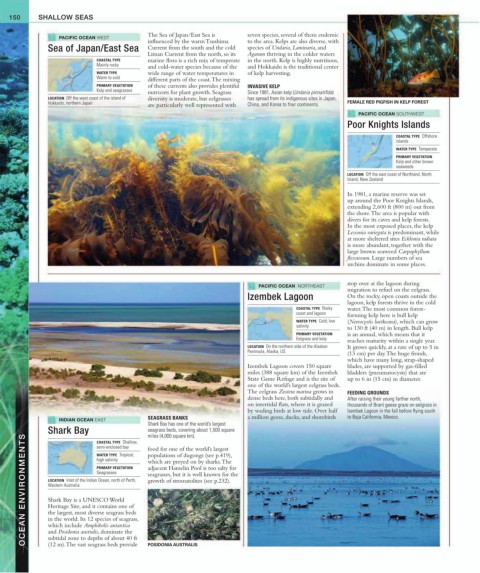
               Hokkaido, northern Japan      are particularly well represented with   China, and Korea to four continents.  FEMALE RED PIGFISH IN KELP FOREST
                                                                                                            PACIFIC OCEAN SOUTHWEST
                                                                                                        Poor Knights Islands

                                                                                                                       COASTAL TYPE  Offshore
                                                                                                                       islands
                                                                                                                       WATER TYPE  Temperate
                                                                                                                       PRIMARY VEGETATION
                                                                                                                       Kelp and other brown
                                                                                                                       seaweeds
                                                                                                        LOCATION  Off the east coast of Northland, North
                                                                                                        Island, New Zealand

                                                                                                        In 1981, a marine reserve was set
                                                                                                        up around the Poor Knights Islands,
                                                                                                        extending 2,600 ft (800 m) out from
                                                                                                        the shore. The area is popular with
                                                                                                        divers for its caves and kelp forests.
                                                                                                        In the most exposed places, the kelp
                                                                                                        Lessonia variegata is predominant, while
                                                                                                        at more sheltered sites Ecklonia radiata
                                                                                                        is more abundant, together with the
                                                                                                        large brown seaweed Carpophyllum
                                                                                                        flexuosum. Large numbers of sea
                                                                                                        urchins dominate in some places.


                                                                              PACIFIC OCEAN  NORTHEAST  stop over at the lagoon during
                                                                                                        migration to refuel on the eelgrass.
                                                                           Izembek Lagoon               On the rocky, open coasts outside the
                                                                                                        lagoon, kelp forests thrive in the cold
                                                                                         COASTAL TYPE  Rocky   water. The most common forest-
                                                                                         coast and lagoon  forming kelp here is bull kelp
                                                                                         WATER TYPE  Cold; low   (Nereocystis luetkeana), which can grow
                                                                                         salinity       to 130 ft (40 m) in length. Bull kelp
                                                                                         PRIMARY VEGETATION    is an annual, which means that it
                                                                                         Eelgrass and kelp  reaches maturity within a single year.
                                                                           LOCATION  On the northern side of the Alaskan   It grows quickly, at a rate of up to 5 in
                                                                           Peninsula, Alaska, US        (13 cm) per day. The huge fronds,
                                                                                                        which have many long, strap-shaped
                                                                           Izembek Lagoon covers 150 square   blades, are supported by gas-filled
                                                                           miles (388 square km) of the Izembek   bladders (pneumatocysts) that are
                                                                           State Game Refuge and is the site of   up to 6 in (15 cm) in diameter.
                                                                           one of the world’s largest eelgrass beds.
                                                                           The eelgrass Zostera marina grows in   FEEDING GROUNDS
                                                                           dense beds here, both subtidally and   After raising their young farther north,
                                                                           on intertidal flats, where it is grazed   thousands of Brant geese graze on eelgrass in
                                                                           by wading birds at low tide. Over half   Izembek Lagoon in the fall before flying south
                  INDIAN OCEAN EAST          SEAGRASS BANKS                a million geese, ducks, and shorebirds   to Baja California, Mexico.
                                             Shark Bay has one of the world’s largest
               Shark Bay      semi-enclosed bay  seagrass beds, covering about 1,500 square
                                             miles (4,000 square km).
        OCEAN ENVIRONMENTS  LOCATION  Inlet of the Indian Ocean, north of Perth,   which are preyed on by sharks. The
                              COASTAL TYPE  Shallow,
                                             food for one of the world’s largest
                              WATER TYPE  Tropical;
                                             populations of dugongs (see p.419),
                              high salinity
                                             adjacent Hamelin Pool is too salty for
                              PRIMARY VEGETATION
                              Seagrasses
                                             seagrasses, but it is well known for the
                                             growth of stromatolites (see p.232).
               Western Australia
               Shark Bay is a UNESCO World
               Heritage Site, and it contains one of
               the largest, most diverse seagrass beds
               in the world. Its 12 species of seagrass,
               which include Amphibolis antarctica
               and Posidonia australis, dominate the
               subtidal zone to depths of about 40 ft
               (12 m). The vast seagrass beds provide
                                             POSIDONIA AUSTRALIS
   147   148   149   150   151   152   153   154   155   156   157