


Page 156 - (DK) Ocean - The Definitive Visual Guide
P. 156
154     SHALLOW SEAS


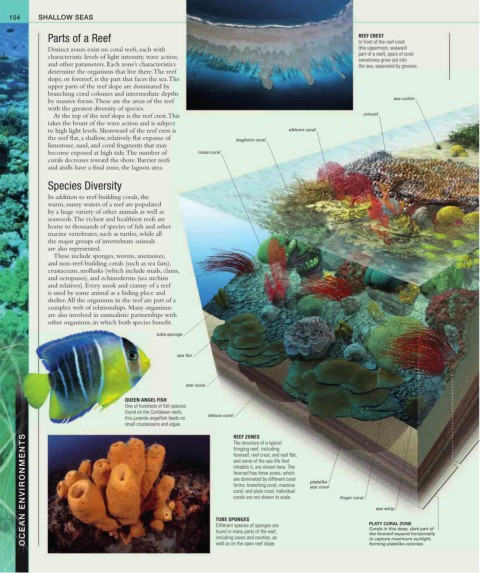
               Parts of a Reef                                                                              REEF CREST
                                                                                                            In front of the reef crest
               Distinct zones exist on coral reefs, each with                                               (the uppermost, seaward
               characteristic levels of light intensity, wave action,                                       part of a reef), spurs of coral
                                                                                                            sometimes grow out into
               and other parameters. Each zone’s characteristics                                            the sea, separated by grooves.
               determine the organisms that live there. The reef
               slope, or forereef, is the part that faces the sea. The
               upper parts of the reef slope are dominated by
               branching coral colonies and intermediate depths
               by massive forms. These are the areas of the reef                                                      sea urchin
               with the greatest diversity of species.
                 At the top of the reef slope is the reef crest. This                                        crinoid
               takes the brunt of the wave action and is subject
               to high light levels. Shoreward of the reef crest is                    elkhorn coral
               the reef flat, a shallow, relatively flat expanse of    staghorn coral
               limestone, sand, and coral fragments that may
               become exposed at high tide. The number of   maze coral
               corals decreases toward the shore. Barrier reefs
               and atolls have a final zone, the lagoon area.

               Species Diversity
               In addition to reef-building corals, the
               warm, sunny waters of a reef are populated
               by a huge variety of other animals as well as
               seaweeds. The richest and healthiest reefs are
               home to thousands of species of fish and other
               marine vertebrates, such as turtles, while all
               the major groups of invertebrate animals
               are also represented.
                 These include sponges, worms, anemones,
               and non-reef-building corals (such as sea fans),
               crustaceans, mollusks (which include snails, clams,
               and octopuses), and echinoderms (sea urchins
               and relatives). Every nook and cranny of a reef
               is used by some animal as a hiding place and
               shelter. All the organisms in the reef are part of a
               complex web of relationships. Many organisms
               are also involved in mutualistic partnerships with
               other organisms, in which both species benefit.
                                                tube sponge


                                                      sea fan


                                                        star coral

                                      QUEEN ANGEL FISH
                                      One of hundreds of fish species
                                      found on the Caribbean reefs,
                                                               lettuce coral
                                      this juvenile angelfish feeds on
                                      small crustaceans and algae.    forereef, reef crest, and reef flat,
        OCEAN ENVIRONMENTS                                       TUBE SPONGES                platelike    finger coral  PLATY CORAL ZONE
                                                                       REEF ZONES
                                                                       The structure of a typical
                                                                       fringing reef, including
                                                                      and some of the sea life that
                                                                      inhabits it, are shown here. The
                                                                      forereef has three zones, which
                                                                      are dominated by different coral
                                                                      forms: branching coral, massive
                                                                                             star coral
                                                                      coral, and platy coral. Individual
                                                                      corals are not shown to scale.
                                                                                                                 sea whip


                                                                 Different species of sponges are
                                                                                                               Corals in this deep, dark part of
                                                                 found in many parts of the reef,
                                                                                                               the forereef expand horizontally
                                                                 including caves and cavities, as
                                                                                                               to capture maximum sunlight,
                                                                 well as on the open reef slope.
                                                                                                               forming platelike colonies.

