


Page 170 - (DK) Ocean - The Definitive Visual Guide
P. 170
168     THE OPEN OCEAN AND OCEAN FLOOR                              OCEAN ZONES

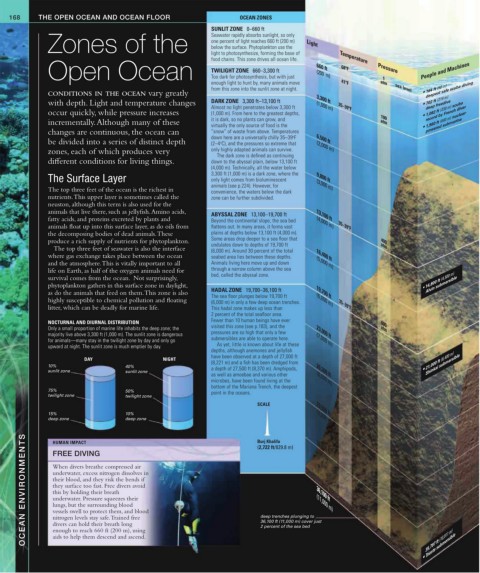
                                                                SUNLIT ZONE   0–660 ft
                                                                Seawater rapidly absorbs sunlight, so only
               Zones of the                                     one percent of light reaches 660 ft (200 m)   Light
                                                                below the surface. Phytoplankton use the
                                                                light to photosynthesize, forming the base of
                                                                food chains. This zone drives all ocean life.  Temperature
               Open Ocean                                       TWILIGHT ZONE   660–3,300 ft   660 ft  68ºF       Pressure    People and Machines

                                                                                               (200  m)
                                                                Too dark for photosynthesis, but with just
                                                                                                                   1
                                                                                                                                deepest safe scuba diving
                                                                enough light to hunt by, many animals move   41ºF  atm
                                                                from this zone into the sunlit zone at night.          sea level  • 164 ft (50 m)
               CONDITIONS IN THE OCEAN vary greatly
                                                                                                                                deep freedive
               with depth. Light and temperature changes        DARK ZONE   3,300 ft–13,100 ft  3,300 ft                       • 702 ft (214 m)
                                                                Almost no light penetrates below 3,300 ft   (1,000 m)  35–39ºF  • 1,082 ft (330 m) scuba
               occur quickly, while pressure increases          (1,000 m). From here to the greatest depths,                    record by French diver
               incrementally. Although many of these            it is dark, so no plants can grow, and            100          • 1,960 ft (600 m) nuclear-
                                                                                                                  atm
                                                                virtually the only source of food is the                        powered submarine
               changes are continuous, the ocean can            “snow” of waste from above. Temperatures
                                                                                        o
                                                                down here are a universally chilly 35–39 F   6,500 ft
               be divided into a series of distinct depth       (2–4 C), and the pressures so extreme that
                                                                   o
               zones, each of which produces very               only highly adapted animals can survive.   (2,000 m)
                                                                  The dark zone is defined as continuing
               different conditions for living things.          down to the abyssal plain, below 13,100 ft
                                                                (4,000 m). Technically, all the water below
                                                                3,300 ft (1,000 m) is a dark zone, where the
               The Surface Layer                                only light comes from bioluminescent   9,800 ft
                                                                animals (see p.224). However, for   (3,000 m)
               The top three feet of the ocean is the richest in   convenience, the waters below the dark
               nutrients. This upper layer is sometimes called the   zone can be further subdivided.
               neuston, although this term is also used for the
               animals that live there, such as jellyfish. Amino acids,   ABYSSAL ZONE   13,100–19,700 ft  13,100 ft
               fatty acids, and proteins excreted by plants and   Beyond the continental slope, the sea bed   (4,000 m)
               animals float up into this surface layer, as do oils from   flattens out. In many areas, it forms vast   35–39ºF
               the decomposing bodies of dead animals. These    plains at depths below 13,100 ft (4,000 m).
               produce a rich supply of nutrients for phytoplankton.   Some areas drop deeper to a sea floor that   400
                                                                undulates down to depths of 19,700 ft
                 The top three feet of seawater is also the interface   (6,000 m). Around 30 percent of the total   atm
               where gas exchange takes place between the ocean   seabed area lies between these depths.   16,400 ft
               and the atmosphere. This is vitally important to all   Animals living here move up and down   (5,000 m)
               life on Earth, as half of the oxygen animals need for   through a narrow column above the sea
               survival comes from the ocean.  Not surprisingly,   bed, called the abyssal zone.                               • 14,800 ft (4,500 m)
               phytoplankton gathers in this surface zone in daylight,                                                          Alvin submersible
               as do the animals that feed on them. This zone is also   HADAL ZONE   19,700–36,100 ft  19,700 ft
                                                                The sea floor plunges below 19,700 ft
               highly susceptible to chemical pollution and floating   (6,000 m) in only a few deep ocean trenches.   (6,000 m)
               litter, which can be deadly for marine life.     This hadal zone makes up less than    35–39ºF
                                                                2 percent of the total seafloor area.
               NOCTURNAL AND DIURNAL DISTRIBUTION               Fewer than 10 human beings have ever               600
               Only a small proportion of marine life inhabits the deep zone; the   visited this zone (see p.183), and the   atm
               majority live above 3,300 ft (1,000 m). The sunlit zone is dangerous    pressures are so high that only a few   23,000 ft
               for animals—many stay in the twilight zone by day and only go   submersibles are able to operate here.   (7,000 m)
               upward at night. The sunlit zone is much emptier by day.   As yet, little is known about life at these
                                                                depths, although anemones and jellyfish
                                                                have been observed at a depth of 27,000 ft
                          DAY                    NIGHT                                                                         • 21,000 ft (6,400 m)
                                                                (8,221 m) and a fish has been dredged from
               10%                    40%                                                                                       Shinkai submersible
               sunlit zone            sunlit zone               a depth of 27,500 ft (8,370 m). Amphipods,   26,300 ft
                                                                as well as amoebae and various other
                                                                microbes, have been found living at the   (8,000 m)
                                                                bottom of the Mariana Trench, the deepest
               75%                    50%
               twilight zone          twilight zone             point in the oceans.
                                                                              SCALE
               15%                    10%                                                      29,500 ft
               deep zone              deep zone                               Burj Khalifa     (9,000 m)

        OCEAN ENVIRONMENTS  When divers breathe compressed air                 deep trenches plunging to   (10,000 m)          • Trieste submersible
                 HUMAN IMPACT
                                                                              (2,722 ft/829.8 m)
                 FREE DIVING
                                                                                               32,800 ft

                 underwater, excess nitrogen dissolves in
                 their blood, and they risk the bends if
                 they surface too fast. Free divers avoid
                 this by holding their breath
                 underwater. Pressure squeezes their
                                                                                               36,100 ft
                 lungs, but the surrounding blood
                                                                                               (11,000 m)
                 vessels swell to protect them, and blood
                 nitrogen levels stay safe. Trained free
                                                                               36,100 ft (11,000 m) cover just
                 divers can hold their breath long
                                                                               2 percent of the sea bed
                                                                                                                                35,797 ft (10,911 m)
                 enough to reach 660 ft (200 m), using
                 aids to help them descend and ascend.

