


Page 171 - (DK) Ocean - The Definitive Visual Guide
P. 171
DEEPEST OCEAN POINTS                                                          ZONES OF THE OPEN OCEAN            169
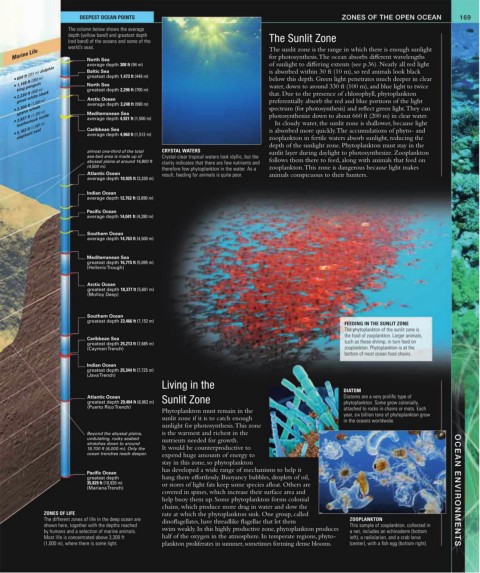
                     The column below shows the average
                     depth (yellow band) and greatest depth
                     (red band) of the oceans and some of the                    The Sunlit Zone
                     world’s seas.                                               The sunlit zone is the range in which there is enough sunlight
    Marine Life                                                                  for photosynthesis. The ocean absorbs different wavelengths
                           North Sea
                           average depth 308 ft (94 m)                           of sunlight to differing extents (see p.36). Nearly all red light
     • 659 ft (201 m) dolphin  Baltic Sea                                        is absorbed within 30 ft (10 m), so red animals look black
                           greatest depth 1,473 ft (449 m)
     • 1,148 ft (300 m)    North Sea                                             below this depth. Green light penetrates much deeper in clear
      king penguin
                                                                                 water, down to around 330 ft (100 m), and blue light to twice
     • 2,230 ft (680 m)    greatest depth 2,296 ft (700 m)                       that. Due to the presence of chlorophyll, phytoplankton
      great white shark
     • 3,300 ft (1,000 m)  Arctic Ocean                                          preferentially absorb the red and blue portions of the light
                           average depth 3,248 ft (990 m)
      sperm whale
                                                                                 spectrum (for photosynthesis) and reflect green light. They can
     • 3,937 ft (1,200 m)  Mediterranean Sea                                     photosynthesize down to about 660 ft (200 m) in clear water.
      leatherback turtle
                           average depth 4,921 ft (1,500 m)
     • 5,183 ft (1,580 m)  Caribbean Sea                                         is absorbed more quickly. The accumulations of phyto- and
                                                                                   In cloudy water, the sunlit zone is shallower, because light
      elephant seal
                           average depth 4,960 ft (1,512 m)
                                                                                 zooplankton in fertile waters absorb sunlight, reducing the
                                                                                 depth of the sunlight zone. Phytoplankton must stay in the
                           almost one-third of the total   CRYSTAL WATERS        sunlit layer during daylight to photosynthesize. Zooplankton
                           sea-bed area is made up of   Crystal-clear tropical waters look idyllic, but the
                           abyssal plains at around 14,800 ft   clarity indicates that there are few nutrients and   follows them there to feed, along with animals that feed on
                           (4,500 m).                                            zooplankton. This zone is dangerous because light makes
                                                 therefore few phytoplankton in the water. As a
                           Atlantic Ocean        result, feeding for animals is quite poor.  animals conspicuous to their hunters.
                           average depth 10,925 ft (3,330 m)
                           Indian Ocean
                           average depth 12,762 ft (3,890 m)
                           Pacific Ocean
                           average depth 14,041 ft (4,280 m)
                           Southern Ocean
                           average depth 14,763 ft (4,500 m)

                           Mediterranean Sea
                           greatest depth 16,715 ft (5,095 m)
                           (Hellenic Trough)

                           Arctic Ocean
                           greatest depth 18,377 ft (5,601 m)
                           (Molloy Deep)


                           Southern Ocean
                           greatest depth 23,466 ft (7,152 m)
                                                                                                        FEEDING IN THE SUNLIT ZONE
                                                                                                        The phytoplankton of the sunlit zone is
                                                                                                        the food of zooplankton. Larger animals,
                           Caribbean Sea                                                                such as these shrimp, in turn feed on
                           greatest depth 25,213 ft (7,685 m)
                           (Caymen Trench)                                                              zooplankton. Phytoplankton is at the
                                                                                                        bottom of most ocean food chains.
                           Indian Ocean
                           greatest depth 25,344 ft (7,725 m)
                           (Java Trench)
                                                 Living in the
                                                                                                       DIATOM
                           Atlantic Ocean        Sunlit Zone                                           Diatoms are a very prolific type of
                           greatest depth 29,404 ft (8,962 m)                                          phytoplankton. Some grow colonially,
                           (Puerto Rico Trench)                                                        attached to rocks in chains or mats. Each
                                                 Phytoplankton must remain in the
                                                                                                       year, six billion tons of phytoplankton grow
                                                 sunlit zone if it is to catch enough
                                                                                                       in the oceans worldwide.
                                                 sunlight for photosynthesis. This zone
                           Beyond the abyssal plains,   is the warmest and richest in the
                           undulating, rocky seabed   nutrients needed for growth.
                           stretches down to around
                           19,700 ft (6,000 m). Only the    It would be counterproductive to
                           ocean trenches reach deeper.  expend huge amounts of energy to
                                                 stay in this zone, so phytoplankton
                                                 has developed a wide range of mechanisms to help it
                           Pacific Ocean
                           greatest depth        hang there effortlessly. Buoyancy bubbles, droplets of oil,
                           35,829 ft (10,920 m)  or stores of light fats keep some species afloat. Others are
                           (Mariana Trench)
                                                 covered in spines, which increase their surface area and                                OCEAN ENVIRONMENTS
                                                 help buoy them up. Some phytoplankton forms colonial
                                                 chains, which produce more drag in water and slow the
              ZONES OF LIFE                      rate at which the phytoplankton sink. One group, called
              The different zones of life in the deep ocean are   dinoflagellates, have threadlike flagellae that let them    ZOOPLANKTON
              shown here, together with the depths reached                                               This sample of zooplankton, collected in
              by humans and a selection of marine animals.    swim weakly. In this highly productive zone, phytoplankton produces    a net, includes an echinoderm (bottom
              Most life is concentrated above 3,300 ft   half of the oxygen in the atmosphere. In temperate regions, phyto-  left), a radiolarian, and a crab larva
              (1,000 m), where there is some light.  plankton proliferates in summer, sometimes forming dense blooms.  (center), with a fish egg (bottom right).

