


Page 237 - (DK) Ocean - The Definitive Visual Guide
P. 237
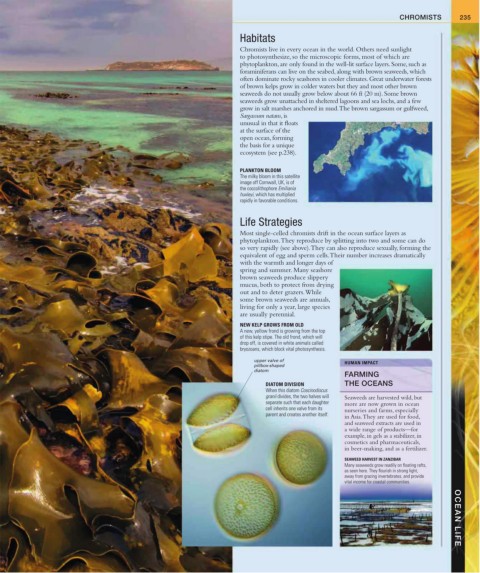
CHROMISTS         235


                                                                        Habitats

                                                                        Chromists live in every ocean in the world. Others need sunlight
                                                                        to photosynthesize, so the microscopic forms, most of which are
                                                                        phytoplankton, are only found in the well-lit surface layers. Some, such as
                                                                        foraminiferans can live on the seabed, along with brown seaweeds, which
                                                                        often dominate rocky seashores in cooler climates. Great underwater forests
                                                                        of brown kelps grow in colder waters but they and most other brown
                                                                        seaweeds do not usually grow below about 66 ft (20 m). Some brown
                                                                        seaweeds grow unattached in sheltered lagoons and sea lochs, and a few
                                                                        grow in salt marshes anchored in mud. The brown sargassum or gulfweed,
                                                                        Sargassum natans, is
                                                                        unusual in that it floats
                                                                        at the surface of the
                                                                        open ocean, forming
                                                                        the basis for a unique
                                                                        ecosystem (see p.238).

                                                                        PLANKTON BLOOM
                                                                        The milky bloom in this satellite
                                                                        image off Cornwall, UK, is of
                                                                        the coccolithophore Emiliania
                                                                        huxleyi, which has multiplied
                                                                        rapidly in favorable conditions.

                                                                        Life Strategies

                                                                        Most single-celled chromists drift in the ocean surface layers as
                                                                        phytoplankton. They reproduce by splitting into two and some can do
                                                                        so very rapidly (see above). They can also reproduce sexually, forming the
                                                                        equivalent of egg and sperm cells. Their number increases dramatically
                                                                        with the warmth and longer days of
                                                                        spring and summer. Many seashore
                                                                        brown seaweeds produce slippery
                                                                        mucus, both to protect from drying
                                                                        out and to deter grazers. While
                                                                        some brown seaweeds are annuals,
                                                                        living for only a year, large species
                                                                        are usually perennial.
                                                                        NEW KELP GROWS FROM OLD
                                                                        A new, yellow frond is growing from the top
                                                                        of this kelp stipe. The old frond, which will
                                                                        drop off, is covered in white animals called
                                                                        bryozoans, which block vital photosynthesis.
                                                                             upper valve of             HUMAN IMPACT
                                                                             pillbox-shaped
                                                                             diatom
                                                                                                        FARMING
                                                                                                        THE OCEANS
                                                                                DIATOM DIVISION
                                                                                When this diatom Coscinodiscus
                                                                                granii divides, the two halves will   Seaweeds are harvested wild, but
                                                                                separate such that each daughter   more are now grown in ocean
                                                                                cell inherits one valve from its   nurseries and farms, especially
                                                                                parent and creates another itself.  in Asia. They are used for food,
                                                                                                        and seaweed extracts are used in
                                                                                                        a wide range of products—for
                                                                                                        example, in gels as a stabilizer, in
                                                                                                        cosmetics and pharmaceuticals,
                                                                                                        in beer-making, and as a fertilizer.
                                                                                                        SEAWEED HARVEST IN ZANZIBAR
                                                                                                        Many seaweeds grow readily on floating rafts,
                                                                                                        as seen here. They flourish in strong light,
                                                                                                        away from grazing invertebrates, and provide
                                                                                                        vital income for coastal communities.   OCEAN LIFE

