


Page 236 - (DK) Ocean - The Definitive Visual Guide
P. 236
234     CHROMISTS


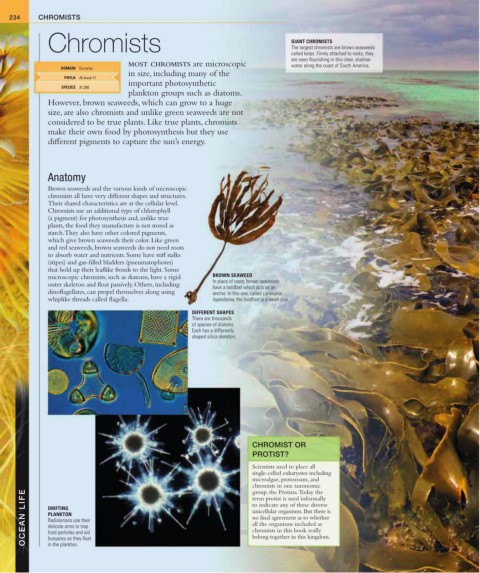
               Chromists                                                                GIANT CHROMISTS
                                                                                        The largest chromists are brown seaweeds
                                                                                        called kelps. Firmly attached to rocks, they
                                                                                        are seen flourishing in this clear, shallow
                                       MOST CHROMISTS are microscopic
                   DOMAIN Eucarya                                                       water along the coast of South America.
                                       in size, including many of the
                    PHYLA At least 11
                                       important photosynthetic
                   SPECIES 31,200
                                       plankton groups such as diatoms.
               However, brown seaweeds, which can grow to a huge
               size, are also chromists and unlike green seaweeds are not
               considered to be true plants. Like true plants, chromists
               make their own food by photosynthesis but they use
               different pigments to capture the sun’s energy.


               Anatomy

               Brown seaweeds and the various kinds of microscopic
               chromists all have very different shapes and structures.
               Their shared characteristics are at the cellular level.
               Chromists use an additional type of chlorophyll
               (a pigment) for photosynthesis and, unlike true
               plants, the food they manufacture is not stored as
               starch. They also have other colored pigments,
               which give brown seaweeds their color. Like green
               and red seaweeds, brown seaweeds do not need roots
               to absorb water and nutrients. Some have stiff stalks
               (stipes) and gas-filled bladders (pneumatophores)
               that hold up their leaflike fronds to the light. Some
               microscopic chromists, such as diatoms, have a rigid   BROWN SEAWEED
                                                                In place of roots, brown seaweeds
               outer skeleton and float passively. Others, including
                                                                have a holdfast which acts as an
               dinoflagellates, can propel themselves along using   anchor. In this one, called Laminaria
               whiplike threads called flagella.                hyperborea, the holdfast is a small disk.
                                                          DIFFERENT SHAPES
                                                          There are thousands
                                                          of species of diatoms.
                                                          Each has a differently
                                                          shaped silica skeleton.


                                                                            CHROMIST OR
                                                                            PROTIST?
                                                                            Scientists used to place all
                                                                            single-celled eukaryotes including
                                                                            microalgae, protozoans, and
                                                                            chromists in one taxonomic
        OCEAN LIFE  DRIFTING                                                to indicate any of these diverse
                                                                            group, the Protista. Today the
                                                                            term protist is used informally
                                                                            unicellular organisms. But there is
               PLANKTON
                                                                            no final agreement as to whether
               Radiolarians use their
                                                                            all the organisms included as
               delicate arms to trap
                                                                            chromists in this book really
               food particles and aid
                                                                            belong together in this kingdom.
               buoyancy as they float
               in the plankton.

