


Page 234 - (DK) Ocean - The Definitive Visual Guide
P. 234
232     BACTERIA AND ARCHAEA


               Bacteria and Archaea                                                                       PEOPLE
                                                                                                          CARL WOESE

                                       THE SMALLEST ORGANISMS ON EARTH are the bacteria                   Born in New York Carl
                  DOMAINS   Bacteria                                                                      Woese (1928—2012) was the
                                       and their relatives, the archaea. Bacteria occupy virtually
                        Archaea                                                                           microbiologist who is responsible
                                       all oceanic habitats, whereas many archaea are confined            for the current division of living
                 KINGDOMS 13
                                                                                                          organisms into three domains,
                   SPECIES Many millions  to extreme environments, such as deep-sea vents. Bacteria       Archaea, Bacteria, and Eucarya, on
                                       and archaea play vital roles in the recycling of matter. Many      the basis of his research into the
                                                                                                          RNA (a chemical related to DNA,
               are decomposers of dead organisms on the ocean floor. Others are remarkable in             called ribonucleic acid) found in
               being able to obtain their energy from minerals in the complete absence of light.          ribosomes. Woese put forward his
                                                                                                          new classification in 1976, but it
                                                                                                          was not until the 1980s that his
               Anatomy                                                     Habitats                       hypothesis was accepted.
               Bacteria and archaea are single-                            Bacteria are found throughout the
               celled organisms that are far smaller                       ocean environment, because nearly
               than any other, even protists. Most                         all habitats provide them with the
               have a cell wall, which, in bacteria,                       materials necessary to obtain
               is made from a substance called                             energy. Most bacteria get energy
               peptidoglycan. None has a nucleus                           by breaking down organic matter.
               or any of the other cell structures                         Much of this matter accumulates
               of more complex organisms                                   on the ocean floor and provides
               (eukaryotes). Some bacteria and                             excellent conditions for the
               archaea can move by rotating                                decomposer bacteria. Bacteria
               threads called flagella; others                             are also found in large numbers
               have no means of propulsion.                                in the water column, feeding on
                 Scientists separated the Archaea                          suspended matter.
               and Bacteria groups on the basis                             A few kinds of bacteria, such as
                                             THRIVING IN THE RIGHT CONDITIONS
               of chemical differences in their cell   The bacterium Nitrosomonas forms colonies   cyanobacteria, can photosynthesize
               make-up. All living cells contain   wherever there is enough ammonia and   and so live nearer to the surface,
               tiny granules (ribosomes), which   oxygen in the water.     in brightly lit waters. Some form
               help to make proteins, but those in                         colonies and build huge structures,
               archaea are differently shaped to those                     called stromatolites, near the shore.
               in bacteria. The oily substances that make                   Many archaea and bacteria can
               up their cell membranes are also different.                 live in extreme conditions, such as
               Additionally, archaea have special molecules                high temperatures, water with high
               associated with their DNA that protect them                 acidity, or low oxygen levels. For
               in the harsh environments in which they live.               example, archaea and bacteria live
                 Scientists now think that their chemical                  around deep-sea vents, getting their
               differences are sufficiently important to rank   HEAT-LOVING ARCHAEA   energy from chemical reactions of
               Archaea as a distinct evolutionary branch of   Most archaea can adapt    methane and sulphide compounds
               life. Initially considered to be primitive, the   to extreme conditions. This   ejected by the vents. Others survive   LIVING ON THE SEA BED
                                                       heat-loving example, GRI,
                                                                                                        Bacterial mats form on the sea bed where
               archaea are now thought to be closer to the   was ejected from the sea    in the very high concentrations    oxygen supply is low. This mat of Beggiatoa sp.
               ancestors of eukaryotes than are the bacteria.  floor in an undersea eruption.  of salt on some sea shores.  is at the mouth of the Mississippi, USA.


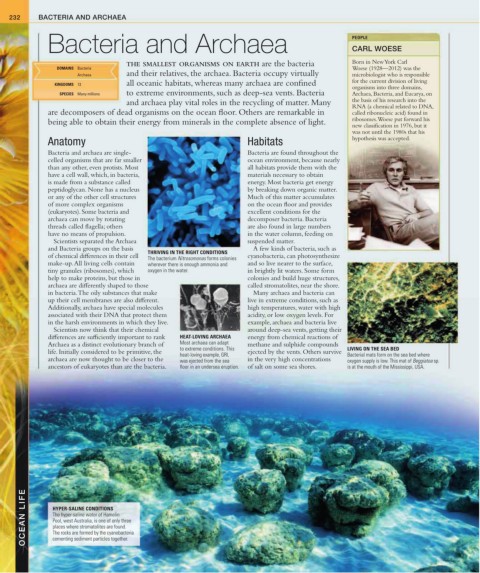
        OCEAN LIFE  HYPER-SALINE CONDITIONS


                 The hyper-saline water of Hamelin
                 Pool, west Australia, is one of only three
                 places where stromatolites are found.
                 The rocks are formed by the cyanobacteria
                 cementing sediment particles together.

