


Page 238 - (DK) Ocean - The Definitive Visual Guide
P. 238
236 CHROMISTS
INFRAPHYLUM DINOFLAGELLATA
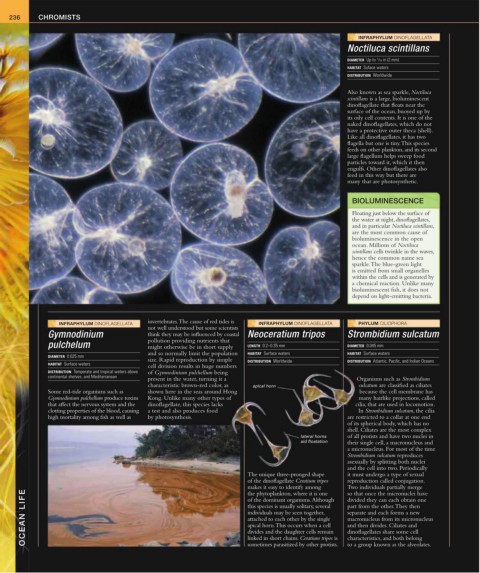
Noctiluca scintillans
1
DIAMETER Up to / 16 in (2 mm)
HABITAT Suface waters
DISTRIBUTION Worldwide
Also known as sea sparkle, Noctiluca
scintillans is a large, bioluminescent
dinoflagellate that floats near the
surface of the ocean, buoyed up by
its oily cell contents. It is one of the
naked dinoflagellates, which do not
have a protective outer theca (shell).
Like all dinoflagellates, it has two
flagella but one is tiny. This species
feeds on other plankton, and its second
large flagellum helps sweep food
particles toward it, which it then
engulfs. Other dinoflagellates also
feed in this way but there are
many that are photosynthetic.
BIOLUMINESCENCE
Floating just below the surface of
the water at night, dinoflagellates,
and in particular Noctiluca scintillans,
are the most common cause of
bioluminescence in the open
ocean. Millions of Noctiluca
scintillans cells twinkle in the waves,
hence the common name sea
sparkle. The blue-green light
is emitted from small organelles
within the cells and is generated by
a chemical reaction. Unlike many
bioluminescent fish, it does not
depend on light-emitting bacteria.
INFRAPHYLUM DINOFLAGELLATA invertebrates. The cause of red tides is INFRAPHYLUM DINOFLAGELLATA PHYLUM CILIOPHORA
not well understood but some scientists
Gymnodinium think they may be influenced by coastal Neoceratium tripos Strombidium sulcatum
pollution providing nutrients that
pulchelum might otherwise be in short supply LENGTH 0.2–0.35 mm DIAMETER 0.045 mm
and so normally limit the population HABITAT Surface waters HABITAT Surface waters
DIAMETER 0.025 mm
size. Rapid reproduction by simple DISTRIBUTION Worldwide DISTRIBUTION Atlantic, Pacific, and Indian Oceans
HABITAT Surface waters
cell division results in huge numbers
DISTRIBUTION Temperate and tropical waters above of Gymnodinium pulchellum being
continental shelves, and Mediterranean
present in the water, turning it a Organisms such as Strombidium
characteristic brown-red color, as apical horn sulcatum are classified as ciliates
Some red-tide organisms such as shown here in the seas around Hong because the cell membrane has
Gymnodinium pulchellum produce toxins Kong. Unlike many other types of many hairlike projections, called
that affect the nervous system and the dinoflagellate, this species lacks cilia, that are used in locomotion.
clotting properties of the blood, causing a test and also produces food In Strombidium sulcatum, the cilia
high mortality among fish as well as by photosynthesis. are restricted to a collar at one end
of its spherical body, which has no
shell. Ciliates are the most complex
lateral horns of all protists and have two nuclei in
aid floatation their single cell, a macronucleus and
a micronucleus. For most of the time
Strombidium sulcatum reproduces
asexually by splitting both nuclei
and the cell into two. Periodically
The unique three-pronged shape it must undergo a type of sexual
of the dinoflagellate Ceratium tripos reproduction called conjugation.
makes it easy to identify among Two individuals partially merge
OCEAN LIFE this species is usually solitary, several part from the other. They then
so that once the micronuclei have
the phytoplankton, where it is one
divided they can each obtain one
of the dominant organisms. Although
separate and each forms a new
individuals may be seen together,
attached to each other by the single
macronucleus from its micronucleus
and then divides. Ciliates and
apical horn. This occurs when a cell
dinoflagellates share some cell
divides and the daughter cells remain
characteristics, and both belong
linked in short chains. Ceratium tripos is
to a group known as the alveolates.
sometimes parasitized by other protists.

