


Page 240 - (DK) Ocean - The Definitive Visual Guide
P. 240
238     CHROMISTS


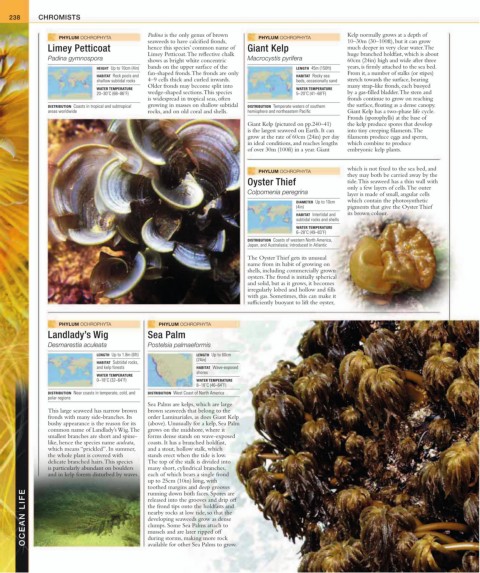
                  PHYLUM OCHROPHYTA          Padina is the only genus of brown   PHYLUM OCHROPHYTA      Kelp normally grows at a depth of
                                             seaweeds to have calcified fronds,                         10–30m (30–100ft), but it can grow
               Limey Petticoat               hence this species’ common name of   Giant Kelp            much deeper in very clear water. The
                                             Limey Petticoat. The reflective chalk                      huge branched holdfast, which is about
               Padina gymnospora             shows as bright white concentric   Macrocystis pyrifera    60cm (24in) high and wide after three
                              HEIGHT  Up to 10cm (4in)  bands on the upper surface of the    LENGTH  45m (150ft)  years, is firmly attached to the sea bed.
                                             fan-shaped fronds. The fronds are only                     From it, a number of stalks (or stipes)
                              HABITAT  Rock pools and                                    HABITAT  Rocky sea
                              shallow subtidal rocks  4–9 cells thick and curled inwards.   beds, occasionally sand  stretch towards the surface, bearing
                                             Older fronds may become split into                         many strap-like fronds, each buoyed
                              WATER TEMPERATURE                                          WATER TEMPERATURE
                              20–30˚C (68–86˚F)   wedge-shaped sections. This species    5–20˚C (41–68˚F)   by a gas-filled bladder. The stem and
                                             is widespread in tropical seas, often                      fronds continue to grow on reaching
               DISTRIBUTION  Coasts in tropical and subtropical   growing in masses on shallow subtidal   DISTRIBUTION  Temperate waters of southern   the surface, floating as a dense canopy.
               areas worldwide               rocks, and on old coral and shells.   hemisphere and northeastern Pacific  Giant Kelp has a two-phase life cycle.
                                                                                                        Fronds (sporophylls) at the base of
                                                                           Giant Kelp (pictured on pp.240–41)    the kelp produce spores that develop
                                                                           is the largest seaweed on Earth. It can   into tiny creeping filaments. The
                                                                           grow at the rate of 60cm (24in) per day   filaments produce eggs and sperm,
                                                                           in ideal conditions, and reaches lengths   which combine to produce
                                                                           of over 30m (100ft) in a year. Giant   embryonic kelp plants.


                                                                                                        which is not fixed to the sea bed, and
                                                                              PHYLUM OCHROPHYTA
                                                                                                        they may both be carried away by the
                                                                           Oyster Thief                 tide. This seaweed has a thin wall with
                                                                                                        only a few layers of cells. The outer
                                                                                                        layer is made of small, angular cells
                                                                           Colpomenia peregrina
                                                                                         DIAMETER  Up to 10cm   which contain the photosynthetic
                                                                                         (4in)          pigments that give the Oyster Thief
                                                                                         HABITAT  Intertidal and   its brown colour.
                                                                                         subtidal rocks and shells
                                                                                         WATER TEMPERATURE
                                                                                         6–28˚C (49–83˚F)
                                                                           DISTRIBUTION  Coasts of western North America,
                                                                           Japan, and Australasia; introduced in Atlantic

                                                                           The Oyster Thief gets its unusual
                                                                           name from its habit of growing on
                                                                           shells, including commercially grown
                                                                           oysters. The frond is initially spherical
                                                                           and solid, but as it grows, it becomes
                                                                           irregularly lobed and hollow and fills
                                                                           with gas. Sometimes, this can make it
                                                                           sufficiently buoyant to lift the oyster,


                  PHYLUM OCHROPHYTA             PHYLUM OCHROPHYTA
               Landlady’s Wig                Sea Palm

               Desmarestia aculeata          Postelsia palmaeformis
                              LENGTH  Up to 1.8m (6ft)     LENGTH  Up to 60cm
                                                           (24in)
                              HABITAT  Subtidal rocks,
                              and kelp forests             HABITAT  Wave-exposed
                                                           shores
                              WATER TEMPERATURE
                              0–18˚C (32–64˚F)             WATER TEMPERATURE
                                                           8–18˚C (46–64˚F)
               DISTRIBUTION  Near coasts in temperate, cold, and   DISTRIBUTION  West Coast of North America
               polar regions
                                             Sea Palms are kelps, which are large
               This large seaweed has narrow brown   brown seaweeds that belong to the
               fronds with many side-branches. Its   order Laminariales, as does Giant Kelp
               bushy appearance is the reason for its   (above). Unusually for a kelp, Sea Palm
               common name of Landlady’s Wig. The   grows on the midshore, where it
               smallest branches are short and spine-   forms dense stands on wave-exposed
               like, hence the species name aculeata,   coasts. It has a branched holdfast,
               which means “prickled”. In summer,   and a stout, hollow stalk, which
               the whole plant is covered with   stands erect when the tide is low.
               delicate branched hairs. This species    The top of the stalk is divided into
               is particularly abundant on boulders   many short, cylindrical branches,
               and in kelp forests disturbed by waves.  each of which bears a single frond
                                             up to 25cm (10in) long, with
                                             toothed margins and deep grooves
        OCEAN LIFE                           the frond tips onto the holdfasts and
                                             running down both faces. Spores are
                                             released into the grooves and drip off
                                             nearby rocks at low tide, so that the
                                             developing seaweeds grow as dense
                                             clumps. Some Sea Palms attach to
                                             mussels and are later ripped off
                                             during storms, making more rock
                                             available for other Sea Palms to grow.

