


Page 370 - (DK) Ocean - The Definitive Visual Guide
P. 370
368     ANIMAL LIFE


               Reptiles                                                                                   HUMAN IMPACT
                                                                                                          EXPLOITATION

                                       DURING THE JURASSIC PERIOD, over 140 million years ago,            All marine reptiles, apart from
                   DOMAIN  Eucarya                                                                        sea snakes, have a long history
                                       reptiles were the largest animals in the oceans. Their place has   of exploitation by humans for
                  KINGDOM Animalia
                                       since been taken by mammals, leaving few reptiles that are         food, skins, or shells. Turtles face
                   PHYLUM Chordata                                                                        the additional hazard of being
                                       wholly marine. Of these, turtles are the most widespread, and      accidentally caught in fishing nets,
                    CLASS Reptilia
                                       sea snakes are the most diverse. Apart from the leatherback        and numbers of all seven species
                   ORDERS 4                                                                               have steeply declined. Marine
                                       turtle, almost all are confined to warm-water regions, with        turtles are now protected by
                   SPECIES About 7,723
                                       the largest numbers around coasts and on coral reefs.              international legislation.
                                                                                                          ILLEGAL SOUVENIRS
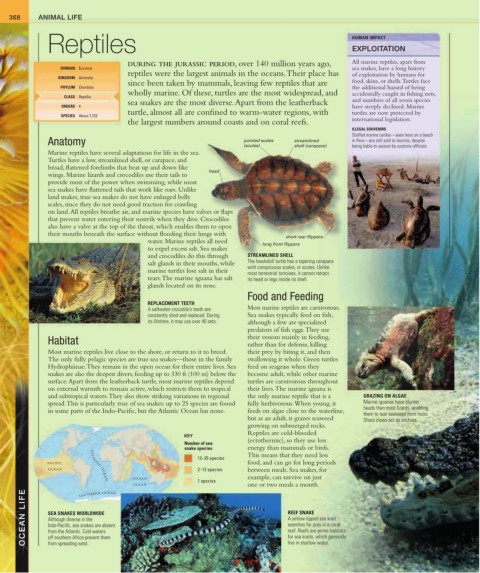
                                                                                                          Stuffed marine turtles—seen here on a beach
               Anatomy                                                    pointed scales   streamlined    in Peru—are still sold to tourists, despite
                                                                          (scutes)       shell (carapace)  being liable to seizure by customs officials.
               Marine reptiles have several adaptations for life in the sea.                              .
               Turtles have a low, streamlined shell, or carapace, and
               broad, flattened forelimbs that beat up and down like
                                                               head
               wings. Marine lizards and crocodiles use their tails to
               provide most of the power when swimming, while most
               sea snakes have flattened tails that work like oars. Unlike
               land snakes, true sea snakes do not have enlarged belly
               scales, since they do not need good traction for crawling
               on land. All reptiles breathe air, and marine species have valves or flaps
               that prevent water entering their nostrils when they dive. Crocodiles
               also have a valve at the top of the throat, which enables them to open
               their mouths beneath the surface without flooding their lungs with
                                                                                      short rear flippers
                                             water. Marine reptiles all need
                                                                               long front flippers
                                             to expel excess salt. Sea snakes
                                             and crocodiles do this through   STREAMLINED SHELL
                                             salt glands in their mouths, while   The hawksbill turtle has a tapering carapace
                                                                           with conspicuous scales, or scutes. Unlike
                                             marine turtles lose salt in their
                                                                           most terrestrial tortoises, it cannot retract
                                             tears. The marine iguana has salt   its head or legs inside its shell.
                                             glands located on its nose.
                                                                           Food and Feeding
                                             REPLACEMENT TEETH
                                             A saltwater crocodile’s teeth are    Most marine reptiles are carnivorous.
                                             constantly shed and replaced. During    Sea snakes typically feed on fish,
                                             its lifetime, it may use over 40 sets.  although a few are specialized
                                                                           predators of fish eggs. They use
               Habitat                                                     their venom mainly in feeding,
                                                                           rather than for defense, killing
               Most marine reptiles live close to the shore, or return to it to breed.    their prey by biting it, and then
               The only fully pelagic species are true sea snakes—those in the family   swallowing it whole. Green turtles
               Hydrophiinae. They remain in the open ocean for their entire lives. Sea   feed on seagrass when they
               snakes are also the deepest divers, feeding up to 330 ft (100 m) below the   become adult, while other marine
               surface. Apart from the leatherback turtle, most marine reptiles depend   turtles are carnivorous throughout
               on external warmth to remain active, which restricts them to tropical   their lives. The marine iguana is
               and subtropical waters. They also show striking variations in regional   the only marine reptile that is a   GRAZING ON ALGAE
               spread. This is particularly true of sea snakes: up to 25 species are found   fully herbivorous. When young, it    Marine iguanas have blunter
               in some parts of the Indo-Pacific, but the Atlantic Ocean has none.  feeds on algae close to the waterline,    heads than most lizards, enabling
                                                                                                             them to tear seaweed from rocks.
                                                                           but as an adult, it grazes seaweed   Sharp claws act as anchors.
                                                                           growing on submerged rocks.
                                                                           Reptiles are cold-blooded
                                                        KEY
                                                                           (ectothermic), so they use less
                                                        Number of sea
                                                        snake species      energy than mammals or birds.
                                                                           This means that they need less
                                                            12–25 species
               PACIFIC      ATLANTIC OCEAN                                 food, and can go for long periods
               OCEAN                                        2–12 species   between meals. Sea snakes, for
                                                                           example, can survive on just
                                        INDIAN
                                                            1 species
                                        OCEAN                              one or two meals a month.
        OCEAN LIFE  SEA SNAKES WORLDWIDE                                               REEF SNAKE
                        SOUTHERN OCEAN
                                                                                       A yellow-lipped sea krait
               Although diverse in the
                                                                                       searches for prey in a coral
               Indo-Pacific, sea snakes are absent
                                                                                       reef. Reefs are prime habitats
               from the Atlantic. Cold waters
                                                                                       for sea kraits, which generally
               off southern Africa prevent them
                                                                                       live in shallow water.
               from spreading west.

