


Page 371 - (DK) Ocean - The Definitive Visual Guide
P. 371
REPTILES       369


             Reproduction                                                      REPTILE CLASSIFICATION

             True sea snakes are the only reptiles that reproduce at sea. They give
             birth to live young (they are viviparous) after a gestation period of up to    Three orders of living reptiles contain marine species. The fourth
             11 months—much longer than most terrestrial species. All other marine   order includes only the tuataras, which are terrestrial. Snakes make
             reptiles, including sea kraits and marine turtles, lay their eggs on land.   up the vast majority of marine reptiles. Others, such as wart snakes
             Many of these animals breed on remote beaches and islands, and the   and terrapins, live in fresh water, occasionally entering the sea.
             adults sometimes arrive simultaneously and in large numbers. The eggs                    subfamily Hydrophiinae, spend their lives at
                                           are incubated by ambient warmth,   TURTLES AND TORTOISES   sea, while sea kraits (members of the family
                                                                          Order Chelonia
                                           and in crocodiles and turtles, the                         Elapidae) breed on land. Seagoing lizards
                                           nest temperature determines the   About 300 species        are all semiterrestrial; only one species, the
                                                                          Seven turtle species are exclusively marine.
                                           sex ratio of the hatchlings. Once   Typical marine turtles (six species) have a   marine iguana, gets all its food offshore.
                                           the eggs have hatched, growth    hard carapace. The separately classified
                                           is fast, but mortality can be high.   leatherback turtle has a rubbery carapace.  CROCODILES AND ALLIGATORS
                                                                                                      Order Crocodilia
                                           Parental care is rare in marine
                                           reptiles; female crocodiles are an   SNAKES AND LIZARDS    23 species
                                                                                                      Only the American crocodile and the
                                           exception, guarding their nests    Order Squamata          saltwater crocodile live in both fresh
                                           and carrying their young to water                          water and the sea. Crocodilians usually
                                                                          7,400 species
                                           after they have hatched.       About 70 species of snakes live in salt   feed at the surface, rarely diving more
                                                                          water. True sea snakes, belonging to the   than a few yards when at sea.
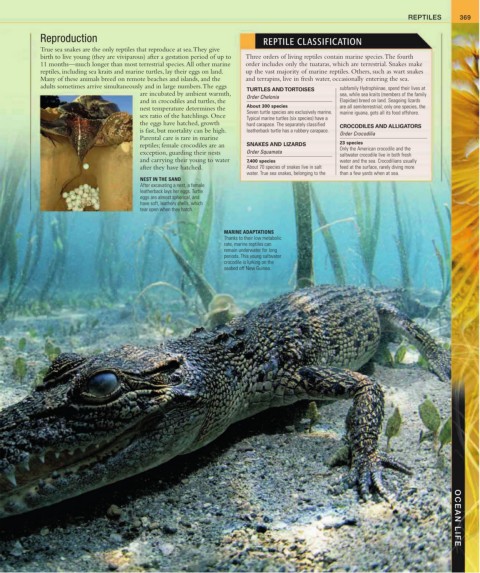
                                           NEST IN THE SAND
                                           After excavating a nest, a female
                                           leatherback lays her eggs. Turtle
                                           eggs are almost spherical, and
                                           have soft, leathery shells, which
                                           tear open when they hatch.


                                                                    MARINE ADAPTATIONS
                                                                    Thanks to their low metabolic
                                                                    rate, marine reptiles can
                                                                    remain underwater for long
                                                                    periods. This young saltwater
                                                                    crocodile is lurking on the
                                                                    seabed off New Guinea.                                               OCEAN LIFE

